Monday, July 04, 2011

Michigan Redistricting: Congressional Map Passed

The state legislature has passed the Republican plan for redistricting Michigan congressional districts. The plan has been analyzed at several other sites, as congressional plans attract more attention than legislative ones.

Michigan Redistricting Maps
Redistricting: Hail To the Michigan GOP?
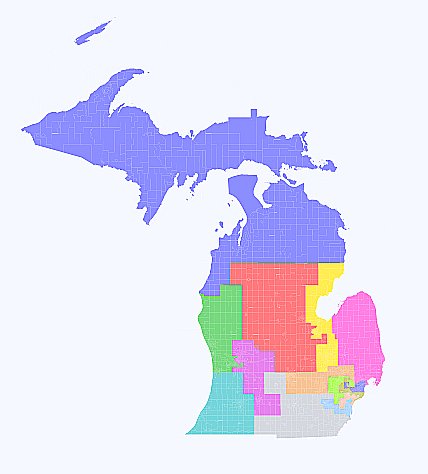
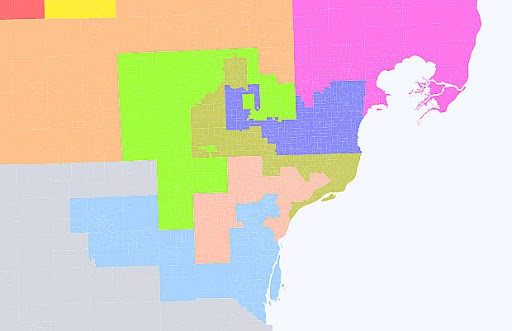

Here are brief district descriptions.

1. Benishek (R) Upper Peninsula, northern lower peninsula.
2. Huizinga (R) West Michigan coast, Walker, Grandville, Wyoming, Kentwood.
3. Amash (R) Kent excluding Grand Rapids suburbs, Ionia, Barry, Calhoun.
4. Camp (R) Central lower peninsula.
5. Kildee (D) Genesee, Saginaw area, west Tuscola, Bay, Arenac, Iosco.
6. Upton (R) Southwest Michigan.
7. Walberg (R) South-central Michigan.
8. Rogers (R) Livington, north Oakland, Ingham.
9. Levin (D) and Peters (D) south Macomb, Royal Oak, Bloomfield.
10. Miller (R) North Macomb, St. Clair, Huron, Sanilac, Lapeer, east Tuscola.
11. McCotter (R) Northwest Wayne, Southwest Oakland, Troy.
12. Dingell (D) Ann Arbor, Ypsilanti, Downriver, Dearborn.
13. Clarke (D) south, west Detroit, Redford, Westland, Romulus, Dearborn Heights.
14. Conyers (D) north Detroit, Grosse Pointes, Southfield, Oak Park, Farmington, Pontiac.

Republican Michigander has written more detailed district descriptions. He also compiled election results in the 2004 and 2008 presidential elections and a recent congressional election broken down by jurisdiction.

Congressional District 1 - Redistricted (MI-01)
Congressional District 2 - Redistricted (MI-02)
Congressional District 3 - Redistricted (MI-03)
Congressional District 4 - Redistricted (MI-04)
Congressional District 5 - Redistricted (MI-05)
Congressional District 6 - Redistricted (MI-06)
Congressional District 7 - Redistricted (MI-07)
Congressional District 8 - Redistricted (MI-08)
Congressional District 9 - Redistricting (MI-09)
Congressional District 10 - Redistricted (MI-10)
Congressional District 11 - Redistricted (MI-11)
Congressional District 12 - Redistricted (MI-12)
Congressional District 13 - Redistricted (MI-13)
Congressional District 14 - Redistricted (MI-14)

Here are more vote totals from 2008 and the average of the governor, secretary of state, and attorney general races from 2006. (via Ryan_in_SEPA at Red Racing Horses)

District (Color) McCain/Obama DRA Average (GOP/Democrat)

MI-1 (Navy Blue) 48.4/49.8 55/45
MI-2 (Dark Green) 50.3/48.1 63.4/36.6
MI-3 (Purple) 48.7/49.6 60.6/39.4
MI-4 (Red) 48.6/49.7 58/42
MI-5 (Yellow) 35.4/63 56.2/43.8
MI-6 (Teal) 45.2/53.1 56/44
MI-7 (Gray) 47.4/50.9 57.1/42.9
MI-8 (Brown) 46.6/52 59.7/40.3
MI-9 (Blue) 40.2/58 50/49.6
MI-10 (Pink) 50.1/48.1 60.1/39.9
MI-11 (Lime) 48.3/50.2 61.2/38.8
MI-12 (Light Blue) 31.4/66.9 42.3/57.7
MI-13 (Tan) 15.7/83.2 25.8/74.2
MI-14 (Olive) 18.5/80.8 70.6/29.4

Many observers have detailed the basic features of the map. Gary Peters' district is carved into four pieces. Most of the Republican districts get safer. Thad McCotter is the big winner, with his district getting about four points more Republican. All the other incumbents get about one point safer, except for Amash, who loses one point.
  • Benishek adds the Grand Traverse area and loses areas north of Bay City
  • Huizinga loses a couple northern counties and takes some Grand Rapids suburbs from Amash
  • Amash takes Calhoun from Walberg
  • Camp takes Clinton and south Schiawassee back from Rogers (he had them in the 90s)
  • Upton adds north Allegan, a heavily Republican area
  • Walberg loses Calhoun (including Mark Schauer's base) and takes Monroe from Dingell
  • Rogers takes some of north Oakland from Peters
  • Miller takes the majority of Tuscola from Kildee and loses a chunk of Sterling Heights
  • McCotter loses Redford, Westland, and Van Buren and adds Waterford and Troy
The districts are all safe for their current incumbents.

Nonetheless, there are some issues that have either gone unremarked or misunderstood.

3. Some commenters have speculated that the legislature was trying to weaken Amash. I would have preferred that Huizinga take part of Grand Rapids rather than the suburbs. Nonetheless, this district is not vulnerable in the general election and is the second or third most Republican in Michigan.

Some have also speculated that they may have wanted to weaken Amash for a primary challenge by former secretary of state Terri Land. I would be very skeptical of this, as Amash has not voiced any complaints about the map. Of the area Amash lost, he did well in Wyoming, Walker, and Grandville in the primary. Kentwood was dominated by Bill Hardimann, who was mayor there before he was a state senator.

Calhoun County may have something of a reputation for moderation, but this is exaggerated. Much of this has to do with longtime state senator Joe Schwarz. But it has also voted for state reps Jerry VanderRoest and Jase Bolger, who are hardly moderates.

Nonetheless, Amash won almost all areas of the district over two credible primary opponents. The only way he would have a chance of losing a primary is if Right to Life didn't endorse him. Some folks were miffed when he voted present on defunding Planned Parenthood. (He supports defunding them but didn't like singling out an organization.) As long as Amash has the support of the Devos family, I can't see Right to Life abandoning him.

6. People keep saying that the sixth district would be vulnerable as an open seat. I don't agree. Their opinion seems to follow from Presidential election results. People don't realize that John McCain publicly pulled his campaign out of Michigan, which netted him the votes of some upset independents and joiners who wanted to be on the winning side.

While the sixth has occasionally gone democrat at the top of the ticket, this doesn't hold in downballot races. The district has all Republican state senators. Moreover this has been true for many decades, with term limits ensuring frequent turnovers. Only the Kalamazoo seat has been close, and it has still leaned Republican.

There is one solidly democrat state representative in Kalamazoo and seven Republicans. Again, it has stayed this way for many decades. Only two of the Republican districts have even had close races in 2008. Only one county commission has had a democrat majority (Kalamazoo, 2006-2010).

9. Commentators have discussed the options for Gary Peters. The consensus (which is correct) is that he would have no chance against Sander Levin. Actually, he might not have an easy time even if Levin retired. The new district 9 is based in south Macomb, which likes a particular type of democrat. Macomb democrats are white, blue collar, pro-union, pro-gun, and often pro-life. Peters doesn't fit the bill.

The other widely discussed option is running in McCotter's district. But this district has basically no democrat areas left. Peters would lose here.

Oddly the option that seems clearly the best shot for Peters does not seem to have been mentioned anywhere. He could run against John Conyers in the new 14th district. He would certainly take some flack for running in a black-majority district, but that hardly makes it unwinnable. Due to clever line-drawing, Conyers has only about 20% of his old constituents. Part of that black majority is Pontiac, which is currently in Peters' district. Southfield is full of middle-class blacks who fled Detroit, and probably wouldn't be thrilled with Conyers.

Conyers is 82 and hasn't had a remotely competitive race (primary or general) in decades. His wife Monica is in state prison for corruption when she was on the Detroit city council. I suspect that he may be vulnerable to a strong primary challenge.

11. Thad McCotter is currently running for president, and nobody seems quite sure why. The best guess I've heard is that he is hoping to get a talk show. People seem to think that McCotter will not run for reelection, though I don't know that this is certain.

If he doesn't the seat will be open. Some commenters assume that term-limited state rep. Marty Knollenberg is a shoo-in for the nomination. True, he is the son of Congressman Joe Knollenberg, who was defeated by Peters in 2008. But Knollenberg has had Republican detractors on both the left and the right. He was primaried by liberal Republican former state rep. Pat Godchaux in 2006. She got about 30%.

I would expect a tough fight for the nomination for this seat. A top candidate for conservatives and the Tea Party if he chose to run would be Senator Pat Colbeck of Canton.

Michigan House to Vote on E-Verify

From Fox News Latino (!!)


Dave Agema's bill to mandate E-Verify in Michigan may be coming to a vote soon in the state house. E-Verify is a federal program for employers to easily verify whether their employees are in the country legally.

Rick Snyder has been an open borders type, so it isn't clear whether he would sign this. The Farm Bureau opposes having to hire people who are in this country legally.

Saturday, July 02, 2011

Michigan Redistricting: Legislative Maps Passed

The Michigan legislature has passed the Republican legislative redistricting plans on mostly party-line votes. I have previously analyzed the Republican proposals, but the plans have been amended since then. I posted updated analyses on the political group blog Red Racing Horses, which is the conservative counterpart to the old Swing State Project.


The only changes to the senate plan were in Wayne County, where the Republicans agreed to the democrats' plan. This has no partisan impact, but it made the districts a little more compact and friendly for their incumbents. Two Detroit senators voted for the final map.

I have to report that I made one mistake in my senate analysis. The district containing Saginaw County (32) dropped Gratiot and added Western Genesee. I had assumed that this made the district worse, but running the numbers showed that it actually got a bit better. This district is still a tossup.

The house plan changed in S Wayne, fixing one of the problems I mentioned. The break on Canton was changed. Most significantly, the map was redrawn in Genesee. I don't much like the new Genesee map, and I think the first one was better.

In addition to the problems I mentioned before, I noticed that it is possible to draw tossup/lean R districts based in the Grosse Pointes, W Dearborn, and Canton. I don't know what the GOP was thinking in its Wayne County map.

Well, it's all over now, assuming Rick Snyder signs the maps.

Friday, July 01, 2011

Ann Coulter in Kalamazoo

Ann Coulter recently spoke in Kalamazoo.

Ann Coulter dishes up dirt on liberals during visit to Kalamazoo

-----------------------------

KALAMAZOO - Author and political commentator Ann Coulter didn't take long to set the tone for her 50-minute discussion Saturday at the Radisson Plaza Hotel and Suites.
"It's so good to be back in Michigan, which I've discovered is Native American for 'No more Granholm,'" said Coulter, who was in Kalamazoo to promote her new book, "Demonic: How the Liberal Mob Is Endangering America."

About 50 people paid $50 each to attend a breakfast with Coulter, and about 300 attended book-signing that did not charge admission.

From the onset at the book-signing, Coulter made punchlines out of President Barack Obama, Anthony Weiner, Bill Clinton, Kwame Kilpatrick, Osama bin Laden and others.
Her candid observations were delivered similar to the routine of a standup comedian and yielded the same results from a partisan and appreciative audience.

Coulter, 49, condemned America's involvement in Libya and Afghanistan. Of the latter, she said it's a terrible country with no natural resources, no oil and 70 percent of its people are illiterate.

"There are more goats in Afghanistan than there are flush toilets," she said. "If Obama is so interested in getting rid of dictators, why doesn't he start with (U.S. Secretary of Homeland Security) Janet Napolitano?"

Coulter, a University of Michigan law school alumna, kept the mood light and the audience laughing by dishing out more observations and opinions.

She said contrary to what Obama has said, the killing Osama bin Laden is not the end of terrorism.

"No more than killing Kenny Rogers would be the end of country music," she said. "(Al-Qaida) has vowed revenge and they're really ticked off at us. What were they before, just moody?"

Regarding the care that terrorist prisoners receive at Guantanamo Bay, Coulter said health coverage, exercise, eight hours of sleep and three meals daily shows the prisoners are living better than many free Americans do. Coulter said she's been treated worse at Holiday Inn Express.

Looking ahead to presidential elections next year and in the future, Coulter said the Republicans boast "a strong farm team," led by New Jersey Gov. Chris Christie. Coulter made no secret her support for Christie as a Republican candidate for president next year.

His only flaw, she said, is that "he's too normal to run for president." Coulter also acknowledged Mitt Romney as a viable candidate.

Coulter's Kalamazoo appearance - the fourth of five stops in Michigan this week - was sponsored by Americans For Prosperity. Its deputy state director, Annie Patnaude, said Coulter's views are consistent with ideals supported by the Lansing-based group, including a smaller and financially responsible government.

Battle Creek resident J.D. Davis, 67, said he was impressed with Coulter's presentation and appreciated her humorous spin.

"I appreciate her strong conservative principles and straight talk," he said. "I've always wondered why Congress doesn't stand up to the president ... I have respect for the president's position but the laws that govern the people should be the same laws that govern the president as well."

Davis said he is frustrated that high-profile elected positions, including president, are filled by people who have made a career out of being self-serving politicians.
"That's why I'd vote for a guy like (chairman of the Federal Reserve Bank of Kansas City) Herman Cain. He's just a regular guy, a smart businessman who would make a good president because he's not a politician," Davis said.

Kim Robbins, 43, also from Battle Creek, said she is tired of politicians who say one thing when they run for office and do another once they're elected. Robbins said she shared many of the same views on the world and politics as those expressed by Coulter.

"A lot of decisions made right now will have an impact on my kids 10, 20, 30 years form now, and I don't think a lot of (politicians) look that far forward," Robbins said.

"I try to have open-minded discussions with my oldest kids about Democrats and Republicans, why they make the decisions they do and what they stand for ... it's important because my kids will be the next generation impacted by what happens under Obama and the next president."

Questioning Ann Coulter

I missed this one at the time of Ann Coulter's appearance at Western more than five years ago. (See the February 2006 archive for our coverage at the time.) Julie Mack provides some of the usual liberal sniveling.

From the archives: Julie Mack's take on Ann Coulter's 2006 appearance at Western Michigan University

Regarding Coulter's alledgedly disrespectful treatment of questioners, none of their questions were worth a serious response. See this comment by Chris.
I was there that night working the event. Not every question was "heartfelt," including one question I had to yank the mic away from. And the 20 uniformed police officers operating metal detectors outside the room were required because some not-so-nice students didn't like Pat Buchanan nimbly picking their arguments apart the year before. But you are right, she is pretty tough, that is her shtick. I think it's popular because liberals in general are so disdainful of conservatives (especially on a college campus) that it's refreshing when some conservatives see another refuse to be browbeaten into apologizing for their very existence. On an individual level, she's pretty nice. She even said I had a nice tie...
I concur that Coulter is one of the nicest people that I have ever met.

Outrageous!

A 6th district federal appeals court panel has struck down the Michigan Civil Rights Initiative, which bans racial discrimination.


Thankfully, Attorney General Schuette will fight this ruling.

There are a couple facts the media conveniently declines to mention. The two judges in the majority, R. Guy Cole Jr. and Martha Craig Daughtrey, are both Clinton appointees. (The third judge is a Reagan/Bush 43 appointee.

Second, the group that filed this lawsuit, By Any Means Necessary (BAMN) is a front group for the communist Revolutionary Workers League. See the post below for documentation.


Previous:

Saturday, June 18, 2011

Michigan Redistricting: Official Republican State House Map Released

Michigan Republicans released their official proposal for the state house of representatives district map on Friday.

Wayne Co., Detroit lose clout under GOP plans
Redrawn plan to have ripple effect


For comparison, here is the current state house map.


This author has previously proposed a state house redistricting plan broken into four parts. The basic rules that any plan must satisfy are explained in the first article.

Michigan Redistricting: State House Part I: Wayne County
Michigan Redistricting: State House Part II: Oakland and Genesee
Michigan Redistricting: State House Part III: Macomb and the Thumb
Michigan Redistricting: State House Part IV: The Rest of the State

Many sections of this map are quite similar to the current map, particularly Southwest, south-central, UP, the Thumb, and south Oakland. Wayne loses almost three house districts, with most of the losses coming from Detroit. These are distributed to other parts of the state. Roughly speaking, the new seats are in central Macomb, Ann Arbor suburbs, and Grand Rapids suburbs. Other demographic changes were smaller, and are detailed in the fourth article above.

Overall, this map breaks 23 counties, including three double breaks (St. Clair, Kent, Kalamazoo). The current map breaks 24 counties with two double breaks (St. Clair, Ottawa). My proposed map breaks 22 counties, including three double breaks (St. Clair, Jackson, Kalamazoo).

This map also breaks 18 cities/townships, including breaking Detroit seven (!) ways, and a triple breaks in Warren. These breaks are in Wayne (7), Macomb (5), Oakland (3), Flint, Ann Arbor, and Lansing.

The current map breaks 17 cities/townships, including a triple break for Detroit. These breaks are in Wayne (6/8), Macomb (4), Oakland (2), Genesee (2), Ann Arbor, Lansing, and Grand Rapids. My map breaks 13 cities/townships, including breaking Detroit four ways and two double breaks (Sterling Heights, Clinton Twp). These breaks are in Wayne (5/8), Macomb (3/5), Oakland (2), Flint, Ann Arbor, and Lansing.

There are 12 black-majority districts, ten based in Detroit, and one each in Southfield and Flint. This is the same as the current map despite population loss in Detroit.

DISTRICT DESCRIPTIONS

We provide proposed district number, corresponding current district number, political rating, and geographic description.

1.-10. (1-12,17) Safe D [Detroit]
11. (16) Safe D [Inkster, Garden City]
12. (22) Safe D [Taylor, Romulus]
13. (?) Safe D [Southgate, Allen Park, Dearborn Heights]
14. (13) Safe D [Riverview, Wyandotte, Lincoln Park, Melvindale]
15. (15) Safe D [Dearborn]
16. (18) Safe D [Westland, Wayne]
17. (56) Tossup [N Monroe, Sumpter, Huron]
18. (24) Safe D(---) [St. Clair Shores, Eastpointe]
19. (19) Safe R [Livonia]
20. (20) Safe R(++) [Plymouth, Northville]
21. (21) Tossup [Canton, Van Buren]
22. (42) Safe D [Roseville, E Warren]
23. (23) Tossup [SE Wayne]
24. (new) Safe R(++++) [Harrison, N Clinton, SW Macomb]
25. (25) Tossup(++) [E Sterling Heights, NC Warren]
26. (26) Safe D [Royal Oak, Madison Heights]
27. (27) Safe D [Oak Park, Ferndale, Hazel Park]
28. (28) Safe D [W Warren, Center Line]
29. (29) Safe D [Pontiac, Auburn Hills, Orchard Lake]
30. (30) Safe R [W Sterling Heights, Utica, SE Shelby]
31. (31) Safe D [S Clinton, Fraser, Mt. Clemens]
32. (32) Lean R [Chesterfield, C St. Clair]
33. (33) Safe R [NE Macomb, Macomb Twp.]
34. (34) Safe D [Flint]
35. (35) Safe D [Southfield]
36. (36) Safe R [Shelby, Washington, Bruce]
37. (37) Safe D [Farmington]
38. (38) Safe R [Novi, Lyon]
39. (39) Lean R(+) [W West Bloomfield, Commerce, Wixom]
40. (40) Safe R [Bloomfield, Birmingham, E West Bloomfield]
41. (41) Safe R [Troy, Clawson]
42. (66) Safe R [SE Livingston]
43. (43) Safe R(+) [Waterford, Independence]
44. (44) Safe R [Springfield, White Lake, Highland, Milford]
45. (45) Safe R [Rochester, S Oakland Twp]
46. (46) Safe R [NE Oakland]
47. (47) Safe R [N Livingston]
48. (?) Lean D(+) [Genesee W tier, Fenton, Mundy]
49. (48) Safe D [Flint Twp., Mt. Morris, Vienna, Thetford]
50. (50) Safe D [Burton, Genesee, Davison, Richfield, Forest]
51. (51) Safe R(+) [Grand Blanc, Fenton, NW Oakland]
52. (52) Lean R(++) [W Washtenaw]
53. (53) Safe D [Ann Arbor]
54. (54) Safe D [Ypsilanti]
55. (new) Lean D(+) [Pittsfield, NE Ann Arbor, York, Augusta]
56. (55) Tossup [S Monroe]
57. (57) Tossup [Lenawee]
58. (58) Safe R [Branch, Hillsdale]
59. (59) Safe R [St. Joseph, E Cass]
60. (60) Safe D [Kalamazoo, Kalamazoo Twp.]
61. (61) Safe R(+) [Portage, Oshtemo, Texas, Schoolcraft, Prairie Ronde]
62. (62) Lean D(-) [Battle Creek, Albion, N Calhoun]
63. (63) Safe R [E Kalamazoo, S Calhoun]
64. (64) Tossup [Jackson city, W Jackson]
65. (65) Lean R [N Jackson, SE Eaton]
66. (80) Safe R [Van Buren, Cooper, Alamo, Parchment]
67. (67) Lean R(+) [S Ingham]
68. (68) Safe D [Lansing]
69. (69) Safe D [East Lansing, Meridian]
70. (70) Lean R [Montcalm, N Gratiot]
71. (71) Lean R [Eaton]
72. (72) Safe R [Kentwood, Gaines, NE Allegan]
73. (73) Safe R [Grand Rapids Twp, Plainfield, NE Kent]
74. (new) Safe R(++++) [Grandville, Walker, Alpine, NW Kent]
75. (76) Safe D [central Grand Rapids]
76. (75) Tossup [peripheral Grand Rapids]
77. (77) Safe R [Wyoming, Byron]
78. (78) Safe R(+) [S Berrien, SW Cass]
79. (79) Safe R [N Berrien]
80. (88) Safe R [Allegan]
81. (81) Safe R [NW, E St. Clair]
82. (82) Safe R [Lapeer]
83. (83) Lean R [Sanilac, Port Huron]
84. (84) Lean R [Tuscola, Huron]
85. (85) Safe R(+) [Shiawassee, W Saginaw]
86. (86) Safe R [SE Kent, N Ionia]
87. (87) Safe R [Barry, S Ionia]
88. (74) Safe R [NE Ottawa]
89. (89) Safe R [W Ottawa]
90. (90) Safe R [Holland]
91. (91) Lean R [S, W Muskegon]
92. (92) Safe D [Muskegon city]
93. (93) Safe R [S Gratiot, Clinton]
94. (94) Safe R [Saginaw Twp, E Saginaw]
95. (95) Safe D [Saginaw city]
96. (96) Safe D [Bay]
97. (97) Safe R(+) [Arenac, Gladwin, Clare, E Osceola]
98. (98) Safe R [C Midland, N Bay]
99. (99) Lean R [Isabella, W Midland]
100. (100) Safe R [Newaygo, Oceana, Lake]
101. (101) Lean R [Leelanau, Benzie, Manistee, Mason]
102. (102) Safe R [Wexford, W Osceola, Mecosta]
103. (103) Safe R(++) [Kalkaska, Crawford, Missaukee, Roscommon, Ogemaw]
104. (104) Safe R [Grand Traverse]
105. (105) Safe R [Antrim, Charlevoix, Otsego, Montmorency, Oscoda]
106. (106) Lean D [E Cheboygan, Presque Isle, Alpena, Alcona, Iosco]
107. (107) Lean R [Emmet, Mackinac, Chippewa, N Cheboygan]
108. (108) Lean R [Delta, Menominee, Dickinson]
109. (109) Safe D [Marquette, Alger, Schoolcraft, Luce]
110. (110) Lean D [W Upper Peninsula]

Rating: SR/LR/TU/LD/SD
Old……. 35 / 18 / 12 / 4 / 41
GOP…… 45 / 14 / 8 / 5 / 38
ME:…… 45 / 19 / 5 / 2 / 39

ANALYSIS

My initial reaction to this map was negative. Having analyzed it, I’m a little more favorable, but there are still some real problems. It appears that excessive consideration was given to protecting existing incumbents. But this makes little sense when they will all be term-limited out of office by 2016 at the latest. It is selfish to put short-term incumbents ahead of the long-term interests of the party.

On the plus side, Republicans will gain two of the three new seats that Wayne lost. Various other districts are shored up in
• Plymouth/Northville (loses Wayne)
• Waterford (loses N W Bloomfield, S Waterford)
• W Washtenaw (loses NE Ann Arbor)
• SW Kalamazoo (loses W Kalamazoo Twp)
• S Berrien (loses Dowagiac)
• Shiawassee (loses Bath)
• Clare/Gladwin (loses N Bay)
• NC LP (adds Kalkaska)

Districts are made more competitive in
• West Bloomfield (loses S West Bloomfield)
• Sterling Heights/Warren (adds more of Sterling Heights)
• S Ingham (trades precincts in Lansing)
• Peripheral Grand Rapids (adds W Grand Rapids)

Here are the problems.

1. The map does not comply with the Apol standards as well as either the current map or my proposed map. While the number of county breaks are close in all three, the number of city/township breaks is much larger in the proposed map. This is despite the fact that the map is less favorable to Republicans than my map.

2. Pat Summerville is cut out of his Wayne southern tier district and given largely new territory in Monroe. Most of the territory he won is without an incumbent.

3. There could easily be another lean R district in the Oakland/Genesee area. The proposed map gives Paul Scott a safe district, but at a cost. I drew a district that overlapped Genesee and Oakland and leans R. I also had one fewer break in Oakland.

4. Rick Olsen is given a bad “new” district with the addition of part of Ann Arbor. Admittedly, there aren’t a lot of great options in Washtenaw, though.

5. District 62, a swing district in Calhoun, is effectively sacrificed to the democrats for the decade. All the democrat areas of Calhoun (Battle Creek, Springfield, Bedford, and Albion) are put in one district. Almost certainly the reason this was done is the make the already safe district (63) of Speaker Jase Bolger even safer. In my map, I kept 63 pretty safe but had it absorb Albion and Bedford, giving the GOP a good chance of winning 62. I certainly understand why this was done. But frankly, it is selfish to protect an already safe incumbent who has one term left at the expense of sacrificing a winnable seat for a decade.

If these problems were corrected, the map would be stronger. As the map is still a proposal, there is time for the house Republicans to do the right thing.

Previous articles on Michigan redistricting:
Michigan Redistricting: Two Possible Congressional Maps
Michigan Redistricting: Two Possible State Senate Maps
Michigan Redistricting: State House Part I: Wayne County
Michigan Redistricting: State House Part II: Oakland and Genesee
Michigan Redistricting: State House Part III: Macomb and the Thumb
Michigan Redistricting: State House Part IV: The Rest of the State
Michigan Redistricting: Analysis of Democrats State Senate Plan
Michigan Redistricting: Official Republican State Senate Map Released

POLITICAL UPDATE--Government

This update focuses on government.

Gary North: Confessions of a Washington Reject
Thomas Sowell: Different Decisions
Steve Sailer: Morgenson And Rosner's Reckless Endangerment: On Trail Of Minority Mortgage Meltdown—But Where’s Dubya?
Steve Sailer: AEI’s Wallison Wimps Out On Minority Mortgage Meltdown
James Edwards: Pending Patent Bill Puts 'Global Harmonization' Above American Innovation
Phyllis Schlafly: The Patent Bill is Unconstitutional
Michelle Malkin: Project Gunrunner: Obama's Stimulus-Funded Border Nightmare

POLITICAL UPDATES are archived here.

Friday, June 17, 2011

Michigan Redistricting: Official Republican State Senate Map Released

The Michigan Republicans have released their official proposal for the new state senate redistricting plan.

Senate Redistricting Map Weakens Detroit, Wayne County


For comparison, here is the current state senate map.


This author has previously proposed two senate redistricting plans and analyzed the state democrats’ official proposal. The basic rules that any plan must satisfy are explained in the first article.

Michigan Redistricting: Two Possible State Senate Maps
Michigan Redistricting: Analysis of Democrats State Senate Plan

The Republican plan bears significant resemblance to my first plan. Many of the differences can be explained by trying to avoid putting two senators in the same district. The plan manages to avoid putting any non-term-limited senators together, which is no small feat, as I have seen when drawing maps.

Overall, this is a very solid plan. It should guarantee a Republican majority for the next decade. It is also a cleaner map (outside Wayne County) than the current map is. Nonetheless, there are a few aspects of the map I don’t care for.

First, I’ll describe the districts and then offer analysis of them. The numbers in parentheses are the old districts that the new ones roughly correspond to.

1. (2) Safe D [N Detroit, Grosse Pointes, Redford] Bert Johnson
2. (?) Safe D [central Detroit, Highland Park, Lincoln Park, Southgate, Allen Park] (open?)
3. (1) Safe D [Detroit riverfront, Downriver] Coleman Young
4. (3) Safe D [West-central Detroit, Dearborn, Melvindale] Morris Hood
5. (5) Safe D [W Detroit, Dearborn Heights, Garden City, Inkster] Tupak Hunter (TL)
6. (?) Safe D [SW Wayne, Westland, Taylor] Hoon-Yung Hopgood, Glenn Andersen (TL)
7. (7) Safe R(+) [Livonia, Canton, Plymouth, Northville, Wayne city] Patrick Colbeck
8. (11) Safe R [N/E Macomb] Jack Brandenburg
9. (9) Safe D [Warren, Roseville, Eastpointe, Fraser, S Clinton] Steven Bieda
10. (10) Safe R(++) [Sterling Heights, Macomb, N Clinton] Tory Rocca
11. (14) Safe D [Farmington, Southfield, Oak Park, Madison Heights] Vincent Gregory
12. (12) Safe R [NE Oakland, Pontiac, Bloomfield Twp.] Jim Marleau
13. (13) Safe R(+) [Troy, Rochester, Royal Oak, Birmingham] John Pappageorge (TL)
14. (26) Safe R(++) [SW Genesee, NW Oakland, Waterford] David Robertson
15. Safe R [SW Oakland] Mike Kowall
16. Safe R [Jackson, Hillsdale, Branch] Bruce Caswell
17. Tossup(-) [Monroe, Lenawee] Randy Richardville (TL)
18. Safe D [Ann Arbor, Ypsilanti] Rebekah Warren
19. Safe R(++) [Calhoun, Barry, Ionia] Mike Nofs
20. Tossup(-) [Kalamazoo County] Tonya Schuitmaker (most of current district)
21. Safe R [Berrien, Cass, St. Joseph] John Proos
22. Safe R [Livingston, W Washtenaw] Joe Hune
23. Safe D [Ingham] Gretchen Whitmer (TL)
24. Safe R [Eaton, Clinton, Shiawassee, NE Ingham] Rick Jones
25. Safe R [St. Clair, Sanilac, Huron] Phil Pavlov
26. (new) Safe R(++++) [VanBuren, Allegan, Kentwood] Tonya Schuitmaker (residence)
27. Safe D [Flint, central Genesee] John Gleason (TL)
28. Safe R [N Kent, Walker] Mark Jansen (TL)
29. Tossup [Grand Rapids, SE Kent] Dave Hildenbrand
30. Safe R [Ottawa County] Arlan Meekhof
31. Lean R(+) [Bay, Tuscola, Lapeer] Mike Green
32. Lean D(-) [Saginaw, W Genesee] Roger Khan (TL)
33. Safe R [Montcalm, Isabella, Gratiot, Mecosta, Clare] Judy Emmons
34. Tossup(-) [Muskegon, Newaygo, Oceana] Geoff Hansen
35. Safe R [NC Lower Peninsula] Darwin Booher
36. Tossup(-) [NE Lower Peninsula, Midland] John Moolenaar
37. Safe R [NW Lower Peninsula, E Upper Peninsula] Howard Walker
38. Tossup [Upper Peninsula excluding Mackinac, Chippewa, Luce] Tom Casperson

Rating: SR/LR/TU/LD/SD
Old……. 13 / 6 / 7 / 1 / 11
New…… 19 / 1 / 6 / 1 / 11

COMMENTARY:

The Republican map has the minimum possible six counties broken, with a double break in Genesee. One of my maps also did this, while the other avoided a double break. The democrats’ map had seven breaks plus a double break.

The Detroit districts are pretty messy. However, this is necessary to maintain five black-majority districts while also limiting city breaks. This map manages to avoid breaking Wayne. Detroit is split five ways, which is essential since any all-Detroit district would have too large a black population. I particularly like that they used my “8 Mile district” (1), stretching from the Grosse Pointes to Redford.


Patrick Colbeck (7) gets safer, trading the southern tier for Livonia. Republicans have given up on having two senators in Wayne, which is no longer realistic due to changing demographics. Colbeck would be a strong conservative candidate to replace Thad McCotter when he moves on.

In Macomb, Republicans finally gave in to temptation and split Clinton Township. With no splits, the map gets very difficult for Republicans, while adding just one split makes it possible to put the most democrat areas of the county in one district (9).

Meanwhile, Tory Rocca (10) loses democrat Roseville and S Clinton, adding Macomb Twp. This district contains almost all of Leon Drolet’s old state house district. Could the libertarian-conservative Drolet primary the moderate pro-union Rocca?

Jack Brandenberg (8) adds St. Clair Shores, which was in his old state house district. This district is a little less Republican, but still safe.

District 11 pulls Madison Heights from 13, which drops Bloomfield Twp. and adds Rochester. With John Pappageorge term-limited, this district could see a primary between establishment conservative Marty Knollenberg and staunch conservative Tom McMillin. Knollenberg has announced his intention to run for congress against Gary Peters, but with Peters’ district all but certain to be carved up, he won’t have a district to run in.

District 12 trades Rochester for Bloomfield Twp. It should still be safe. District 15 only loses population to Dave Robertson (renumbered 14), whose district is now primarily Oakland-based. It loses Mt. Morris and Burton, becoming safe.

Bruce Caswell (16) loses St. Jospeh and Lenawee, adding Jackson. This is identical to the 90’s Jackson-based district. Jackson will likely go a fourth straight term without a home-county senator, but when Caswell is term-limited, it should finally have one again.

Randy Richardville (17) is term-limited, and his district becomes a tossup, losing chunks of Jackson and Washtenaw and adding Lenawee. Basically everyone drew this district, as there weren’t any reasonable alternatives.

Mike Nofs (19) drops most of Jackson and adds Barry and Ionia. This district is identical to a proposed district in the original Republican plan ten years ago, before it was amended. If the original district had held, there would never have been a Senator (or Congressman) Mark Schauer. It would be nice to see Jase Bolger primary the moderate, SEIU-friendly Nofs, but I don’t know that there is any chance of that happening.

Kalamazoo County gained enough population that it can become its own district (20). It loses a small chunk of Van Buren. This is bad for Republicans for two reasons. First, senator Tonya Schuitmaker is from Van Buren. Second, the district would become a tossup. Tonya would have to choose between moving to Kalamazoo County, which is most of her current district, or running in a new district (26) centered in Allegan County. While Tonya represented Van Burn and a chunk of Allegan in the state house, folks in Allegan would probably like to have their own senator. Conservatives would do well with current state rep. Bob Genetski.

Rick Jones (24) keeps only Eaton, and his new district becomes a suburban Lansing district. He should still be safe.

Dave Hildenbrand (28) loses Kentwood and adds East GR and GR Twp., which were in his old state house seat. I’m not sure whether this is a partisan improvement. This seat stays a tossup. Meanwhile, 28 will be open and stays solidly Republican. This would be a good seat for Dave Agema, though the majority of his state house seat is in Ottowa.

All the most democrat areas of Genesee get put into one district (27). The Western tier gets combined with Saginaw (32). Democrats may finally break their losing streak in Saginaw. State rep. Ken Horn has a chance here, but I’m rating this seat lean democrat.

Mike Green gets a safer district (31), losing Arenac, Huron, and Sanilac, and adding Lapeer.

Geoff Hansen (34) loses Mason, making this seat a tossup.

John Moolenaar (36) trades Ogemaw and Crawford for Presque Isle. I don’t like this. This seat was very close in 2002 when the democrat candidate was a state rep. from Alpena. Presque Isle is the most democrat part of this district. Losing Ogemaw does move the Sheltrowns (Dave, Joel) out of this district, though.

Overall, this is a solid map, despite some minor problems.

Monday, June 06, 2011

Saturday, May 28, 2011

Michigan Redistricting: County Commission Roundup

County commission redistricting is well underway, with the majority of counties appearing to have completed their new maps. Maps are drawn by a five-member commission consisting of the county prosecutor, treasurer, and clerk, and the chairmen of the Republican and democrat parties. There are a number of rules that must be complied with, which are laid out in the post below on Kalamazoo County.

In particular, the apportionment commission can pick the number of districts, within some boundaries. A trend in many counties has been to reduce the number of districts.

I did detailed analyses of the maps for Kalamazoo and Calhoun Counties. For other counties, I found some newspaper articles. Unfortunately, such articles tend not to do a good job explaining what is going on. Comments from readers in other parts of the state explaining what's happening in their area are welcome.

Kalamazoo: Kalamazoo County Commission Redistricting Plan Adopted

Calhoun: Calhoun County Commission Redistricting Plan Adopted

Oakland: Oakland GOP: Let county boards set districts
Adopted Map: http://www.oakgov.com/clerkrod/elections/approved_map.pdf
(passed by democrats 3-2)

Kent: Kent County board redistricting called 'political gerrymandering
Republican re-districting plan for Kent County board does not include a 'Hispanic' district
Map: Adopted Apportionment Plan

Genesee: Genesee County Republicans and Democrats approve new map for county commissioner districts

Washtenaw: Washtenaw County Board to Shrink from 11 to 9 Commissioners Under Approved County Redistricting Plan

Ingham: Ingham County Redistricting Raises Question

Livingston: Livingston County chooses new commissioner districts

Ottowa: Ottawa County approves new redistricting plan

Muskegon: Four Muskegon County commissioners face unique races after redistricting

Allegan: Reapportionment plan would shrink Allegan County Board from 11 members to 7

VanBuren: Van Buren County board boundaries set - still with seven commissioners

Barry: Reapportionment takes Barry County Commission from eight districts to seven

St. Joseph: 2 seats cut from St. Joseph County Board of Commissioners, making it a 5-member body

Saginaw: Saginaw County Board of Commissioners districts will merge to 11

Bay: Bay County redistricting: Check out the map to see each Bay County district

Marquette: Fewer commissioners for Marquette County
Marquette County residents lay plans to appeal apportionment

Thursday, May 26, 2011

University Professors' Sweet Gig

How do I get in on this?

Michigan Redistricting: Analysis of Democrats State Senate Plan

The Michigan Democrat Party has released its proposed redistricting plan for the Michigan state senate. I previously released two possible maps and discussed the standards that such maps must follow.

Michigan Redistricting: Two Possible State Senate Maps

Here is the map.


Let’s consider their press release.
Michigan Democrats Introduce State Senate Redistricting Map
Map is Fair, Representative, and Avoids Partisan Gerrymandering

LANSING - Michigan Democratic Party Chair Mark Brewer announced today that he has filed a redistricting plan with the State Senate Committee on Redistricting that would ensure voters are fairly represented in Lansing by creating sensible and competitive districts. The Committee had invited the public to submit maps for consideration and Brewer stated that this map deserved their attention.

“Redistricting should be politically fair and avoid partisan gerrymandering when drawing district boundaries,” said Brewer. “The map we’ve submitted is politically fair with 15 Republican, 15 Democratic, and eight swing districts, doesn’t create a single district boundary that would split a city or township in two, and only splits six counties. In short, it’s a map that simply makes sense.”
They don’t say which districts they consider which. I will rate them myself below. It is technically true that “doesn’t create a single district boundary that would split a city … in two”, but the release doesn’t mention that it splits Detroit in five pieces. It is false to say that “doesn’t create a single district boundary that would split a … township in two” since Browntown township in Wayne County is split between districts 1 and 3.

It is also false that the map “only splits six counties”, since it clearly splits seven (Wayne, Oakland, Macomb, Kent, Genesee, Washtenaw, Ingham), including a double split of Genesee. In comparison, my maps both split only six counties. One has a double break in Genesee, the other does not.
Brewer added that the map also follows the requirements of the Federal Voting Rights Act by creating six “majority-minority” districts, five of which would be based in Detroit and one in Oakland County due to the growth of the African-American community through southeast Michigan.
Brewer is wrong about what the Voting Rights Act requires. This article is the best guide to the VRA that I could find.

(Before you flip out, yes I realize that the article comes from Daily Kos. It appears that the author is playing it straight. Of course, second opinions from the legal-minded commenters here are welcome.)

The VRA may require black-majority districts, but it almost certainly does not require “majority-minority” districts, where all the racial minorities are grouped together to form a majority. The second and third standards from Thornburg v. Gingles are definitely not satisfied. While there is nothing prohibiting a majority-minority district in Oakland, it is definitely not required. It is not even clear that Michigan is required to maintain five black-majority districts, given the massive population loss in Detroit. This would be a much closer call, however.
“This is Governor Snyder’s chance to show that he’s willing to put the interests of Michigan’s voters ahead of the interests of his own political party,” added Brewer. “If he is willing to dismiss this fair redistricting plan and instead sign one that is simply a partisan Republican gerrymander, he will send a very clear message to the people of Michigan; that he is just another Lansing politician beholden to special interests.”
(Eyeroll)

There is nothing terribly outrageous about this map, but it is a modest gerrymander and is probably about the best democrats could do without massively violating the rules. Their strategy is not hard to understand. Since they have no control over the process, they will present a slightly slanted plan, claim it is “fair”, and hope to guilt-trip Republicans (Snyder?) into compromising. It isn’t terribly likely to succeed, though it has some nonzero chance (a similar gambit seems to have worked for Republicans in Arkansas).

What is gerrymandered?
  • Mt. Morris is included in the Saginaw-based district. Mt. Morris is the second most democrat area of Genesee, after Flint. This is not necessary and serves only to create a safe democrat district.
  • Ypsilanti area is included in a district with SW Oakland.
  • The minority-majority district in Oakland.
  • Cutting Detroit into strips. This is probably necessary due to the VRA, but it is nonetheless gerrymandering.
Let’s rate the districts.

1. Safe D [Detroit shoreline] Coleman Young
2. Safe D [northern Detroit, Grosse Pointes] Bert Johnson
3. Safe D [central Detroit, Lincoln Park, Southgate] Virgil Smith
4. Safe D [central Detroit, Dearborn] Morris Hood
5. Safe D [western Detroit, Redford, Dearborn Heights] Tupak Hunter (TL)
6. Safe D [SW Wayne] Hoon-Yung Hopgood, Patrick Colbeck
7. Tossup [Westland, Livonia, Plymouth, Northville] Glenn Andersen (TL)
8. Safe D [southern Macomb County] Steven Bieda
9. Lean R [Clinton, Macomb, Chesterfield, Harrison] Jack Brandenburg
10. Safe R [N Macomb County, Sterling Heights] Tory Rocca
11. Safe R [St. Clair, Lapeer] Phil Pavlov
12. Safe R [N Oakland County] Jim Marleau
13. Safe D [Troy, Royal Oak, Ferndale] John Pappageorge (TL)
14. Safe D [Southfield, Pontiac, Bloomfield, Oak Park] Vincent Gregory
15. Lean D [Farmington, West Bloomfield, Waterford, Spring Lake] Mike Kowall
16. Tossup [SW Oakland, Ypsilanti] Open
17. Tossup [Monroe, Lenawee] Randy Richardville (TL)
18. Safe D [Washtenaw County] Rebekah Warren
19. Lean R [Calhoun, Eaton, S Ingham] Mike Nofs, Rick Jones
20. Tossup [Kalamazoo County] Open
21. Safe R [Hillsdale, Branch, Jackson] Bruce Caswell
22. Safe R [Berrien, Cass, St. Jospeh] John Proos
23. Safe D [Ingham County] Gretchen Whitmer (TL)
24. Safe R [Livingston, Shiawassee] Joe Hune
25. Safe R [Allegan, VanBuren, S Kent] Tonya Schuitmaker
26. Safe D [Flint, western Genesee County] John Gleason (TL)
27. Safe R [Clinton, Ionia, Montcalm, Barry] Judy Emmons
28. Safe R [Kent County outside Grand Rapids] Mark Jansen (TL), Dave Hildenbrand
29. Tossup [Grand Rapids, Walker] Open
30. Safe R [Ottawa County] Arlan Meekhof
31. Tossup [the Thumb, E Genesee] Mike Green, David Robertson
32. Safe D [Saginaw, Mt. Morris] Roger Khan (TL)
33. Safe R [Midland, Isabella, Gratiot, Mecosta, Oscela] John Moolenaar, Darwin Booher
34. Tossup [Muskegon, Oceana, Mason, Manistee] Geoff Hansen
35. Safe R [Grand Traverse area] Howard Walker
36. Lean D [NE Lower Peninsula, Bay] Open
37. Safe R [N Lower Peninsula, E Upper Peninsula] Open
38. Tossup [Upper Peninsula excluding Mackinac, Chippewa] Tom Casperson

Here is a summary of the ratings.

Rating: SR/LR/TU/LD/SD
Old……. 13 / 6 / 7 / 1 / 11
New…… 13 / 2 / 8 / 2 / 13

Some parts of the map are actually the same as what I drew. These areas are pretty much forced by the need to avoid breaks. Interestingly, five of the eight tossup districts would have no incumbent and another would pit two Republicans against each other. Just a coincidence, I’m sure.

In any case, this map is not likely to be adopted.

Previous articles on Michigan redistricting:
Michigan Congressional Redistricting: Two Possible Maps
Michigan Redistricting: Two Possible State Senate Maps
Michigan Redistricting: State House Part I: Wayne County
Michigan Redistricting: State House Part II: Oakland and Genesee
Michigan Redistricting: State House Part III: Macomb and the Thumb
Michigan Redistricting: State House Part IV: The Rest of the State

Thursday, May 19, 2011

How Busing Wrecked Kalamazoo

Julie Mack gives some fascinating history of school busing in Kalamazoo.

School Zone blog: 57th anniversary of Brown v. Board of Education coincides with 40th anniversary of Kalamazoo school busing case

It is important to remember that forced segregation and forced integration are both violations of freedom of association. Voluntary association was not given a chance.
By the time integration came to a head here in 1971, schools segregated because of housing patterns had become a civil rights issue. Moreover, Kalamazoo was a changed city: As blacks from the rural South moved to the urban North in massive numbers, Kalamazoo's black population increased from 2,468 in 1950 to 8,534 by 1970. The city's Northside neighborhood underwent a dramatic transformation from a white, Dutch neighborhood to one that was overwhelmingly African-American.

In January 1971, the Kalamazoo school board decided to racially balance the high schools that fall and the junior high schools in fall 1972. The plan for the elementary schools, the most controversial and complicated, was put on hold.

But that April, the U.S. Supreme Court ruled busing was an appropriate method to achieve integration. The pressure now increased for the district to desegregate all its schools immediately. School board meetings attracted overflow crowds and tempers flared. Letters to the editor filled full pages of the Kalamazoo Gazette.

On Friday, May 7, 1971 -- 40 years ago this month -- the school board reversed its January decision and voted 4-3 to racially balance all its schools in the fall.

The vote followed days of drama. The board was to vote on Monday, May 3, but so many people attended the meeting at Loy Norrix High School auditorium that the event was adjourned by the fire marshal.

The board reconvened three days later at Miller Auditorium. More than 2,000 people were in the audience and 130 people spoke. However, a court injunction delayed the actual vote until the next day.

The plan was supported by board members Gerard Thomas, Andrew Luff, Edward Thompson and J. Peter Schma; dissenting were Norman Bruez, A.T. Lacy and Allan Tyler.

Voters expressed their opposition in the June school election. The districts operating millage request was defeated by a 2-1 ratio; two anti-busing candidates Dale Pattison and Jack Hoekstra were elected to the school board, each garnering nearly twice as many votes as their pro-busing counterparts.

The new school board majority rescinded the desegregation plan and Superintendent John Cochran was forced to resign.

By late summer, the school board approved a voluntary desegregation plan. Within a week, Richard Enslen -- who later became a federal judge -- filed a lawsuit on behalf of the Kalamazoo NAACP, naming as plaintiffs 11 black schoolchildren. The lead plaintiff was the stepdaughter of Robert Jones, then an Upjohn chemist who went onto become state representative before he died last fall.

The lawsuit sought a court injunction to impose busing that fall. U.S. District Judge Noel Fox issued the injunction, which was upheld by the appellate court. Three days before the start of school, U.S. Supreme Court Justice Byron White refused to hear the Kalamazoo school board's request to overturn Fox's decision.

When schools opened Sept. 7, 1971, about 10,000 of the districts 16,000 students rode school buses, about 4,000 more than the previous school year.

Kalamazoo was one of only two communities in Michigan to have court-ordered bussing -- Pontiac was the other. And for years, even decades, busing was part of the district's identity.
Busing was the single biggest factor in the decline of Kalamazoo. Current Kalamazoo GOP Chairman Al Heilman, who was a county commissioner in the 1970s, recalls that Republicans controlled the commission 15-2. Heilman represented the Westnedge Hill/Crosstown area, which at the time was a solidly Republican district.

Rather than put up with needlessly long bus rides and liberal social engineering, people began moving to Portage and other outlying areas. Kalamazoo lost a good chunk of its middle class and gradually transformed into a leftist stronghold. Kalamazoo's current depressed condition is largely a result of that decision.
Forty years later, school busing has a mixed record. No question, academic outcomes have improved dramatically for African-Americans, both locally and nationally. In 1970, only 31 percent of U.S. blacks age 25 or older had a high school diploma compared to 54 percent of whites. Today, 84 percent of black adults are high school graduates compared to 87 percent of whites.
More diplomas does not mean better education. Former WMU President Diether Haenicke has stated that many graduates of Kalamazoo Central are functionally illiterate.
On the other hand, there's no question that busing fueled white- and middle-class flight out of Kalamazoo Public Schools. Moreover, the fact that many African-American families continue to live in social isolation in low-income neighborhoods, not to mention the concentration of low-income minority students in a handful of Kalamazoo County schools, speaks to the failures of court-ordered busing as a solution to the problems of poverty and racism in America.

There were plenty of hopes and fears in Kalamazoo 40 years ago. In retrospect, it seems many of the fears were unfounded, but many of the hopes have been unfulfilled.
Sadly, the malefactors behind this decision were rewarded. Richard_Enslen was appointed a federal judge by Jimmy Carter. Robert Jones became mayor of Kalamazoo and and a state representative.

Regular people continue to be hurt by what Thomas Sowell calls the Vision of the Annointed.

Fired for Self-defense

Shame on Walgreens.

Walgreens fires armed worker

Sunday, May 08, 2011

POLITICAL UPDATE--News from Abroad

This update focuses on news from abroad.

Steve Sailer: Obama and Osama: Can We Go Home Now?
Jeffrey Tucker: An Algorean Utopia in Haiti
Kevin Grace: Canada’s Stephen Harper: My Part In His 2011 Election Triumph
Pat Buchanan: When Dictators Fall, Who Rises?
Lew Rockwell: The EU Crack-Up
Pat Buchanan: Are We Allied to a Corpse?
Pat Buchanan: Is Tribalism the Future?
Pat Buchanan: Koran Burning And Muslim Persecution Of Christians—Who Are These People We Are Fighting For?
Pat Buchanan: A Community Organizer Goes to War
Dan Flynn: Muammar Gaddafi, Socialist

POLITICAL UPDATES are archived here.

Michigan Redistricting: State House Part IV: The Rest of the State

The three parts of my analysis of redistricting the Michigan state house focused on southeastern Michigan. This final part finishes the rest of the state.
Michigan Redistricting: State House Part I: Wayne County
Michigan Redistricting: State House Part II: Oakland and Genesee
Michigan Redistricting: State House Part III: Macomb and the Thumb

See the current map here: MICHIGAN'S 110 HOUSE DISTRICTS

Let’s look at the map first and then see where it came from.


The new map must of course account for population shifts in the state. We have already seen that Wayne lost 240000 people, and hence will lose 3 state representatives. Other losses include 10000 each from Genesee and Saginaw. There were smaller losses in the Upper Peninsula, the Thumb, and the Sunrise Coast.

The biggest gain was in Macomb with 53000. Other major gains include Kent with 28000, Ottawa with 25000, Washtenaw with 22000, Livingston with 14000, Kalamazoo with 12000, and Clinton with 11000. Smaller gains were scattered around western and southern Michigan.

It is tricky to say which districts are ‘new’, since each new district is made up of parts of old districts. But we can say definitely which regions gained districts. One went to Kent/Ottawa/Muskegon/Allegan/Kalamazoo, one went to Washtenaw/Monroe/Lenawee/Jackson/Eaton, and one went to a region containing Macomb and the north-central Lower Peninsula. The districts that I designated as ‘new’ (21-23) are in S Kent/NE Allegan, Ann Arbor suburbs, and Port Huron/N Macomb.

The first article above contains the basics on the rules that any map must follow. As before, we want to minimize county and city/township breaks. Hence when a county can contain some number of districts without being broken, it is usually a good idea to implement this. In this map, such counties are:

1 district: Lapeer, Grand Traverse
2 districts: Livingston, Muskegon
3 districts: Ingham, Ottawa
4 districts: Washtenaw
20 districts: Wayne

These areas can be dealt with separately.

SPECIFIC COUNTIES

Drawing districts in Ingham is tricky because there appear to be several discontiguous precincts. The only district in this county that is winnable for Republicans is the out-county district (67), although it has been held by Byrums all decade. It is possible to marginally improve this district while maintaining one city break (Lansing) by taking a different chunk of Lansing. If two breaks are allowed, it can be made nearly safe by excising Lansing and replacing it with a chuck of Meridian.


The question for Republicans in Washtenaw is whether to go for one safe seat or two marginal seats. This time, I went for the safe route. I created a new democrat seat (22) in the Ann Arbor suburbs. This takes the pressure off 52 and 55, which have been democrat as often as not. There is one break in Ann Arbor.


In Kent County it would be possible to have exactly seven districts by underpopulating them, but the smallest number of breaks that I could find in this scenario is four. However, if Kent and Allegan combine for eight districts, it is possible to avoid any city/township breaks.


This depends on breaking Grand Rapids into exactly two districts, which are which are very near the upper threshold. I tried to create a Grand Rapids district friendly to Republicans. The new 75 is better than its current incarnation, but I wouldn’t rate it any better than a tossup. This is pushing it a bit with respect to clean city breaks. District 76 is near minority-majority.


In the Kalamazoo/Calhoun area, several improvements are possible. Due to population growth, Kalamazoo and Calhoun cannot combine solely. Adding VanBuren with these counties allows them to share five districts. Kalamazoo city and most of K Township combine for one safe dem district (60). (This does not count as a break due to Apol standard C8B.) This makes district 61 safe.

District 62 is a swing district dominated by Battle Creek. Improving it requires stripping out Albion, its only other dem area. Albion has to go to district 63 (Jase Bolger’s district), making it a bit weaker, but still safe. Would the Speaker accept this for the good of the party?

District 80 loses a chunk of Allegan and adds the southern tier of Kalamazoo.


Now let’s zoom out and look at the statewide map. Many shifts are necessary to account for population changes. Some can also help Republicans. Dividing Cass differently (adding Dowagiac to 59) makes 78 safer. Shifting Ionia city to 87 helps 70 a bit.

The northeastern Lower Peninsula is carved up in a way that should be an improvement. District 105 adds the dem area of Presque Isle, but is still safe. District 106 takes in more of the Lake Huron coastline, but is no worse than before. The new 97, anchored by Missaukee and N Midland, is improved. The new 103, with Kalkaska and Otsego, is also improved.

BREAKS, POPULATION, AND VOTING RIGHTS

Overall, this map breaks 22 counties, including three double breaks (St. Clair, Jackson, Kalamazoo). The current map breaks 23 counties with two double breaks (St. Clair, Ottawa).

This map also breaks 13 cities/townships, including breaking Detroit four ways and two double breaks (Sterling Heights, Clinton Twp). These breaks are in Wayne (5/8), Macomb (3/5), Oakland (2), Flint, Ann Arbor, and Lansing. The current map breaks 17 cities/townships, including a triple break for Detroit. These breaks are in Wayne (6/8), Macomb (4), Oakland (2), Genesee (2), Ann Arbor, Lansing, and Grand Rapids.

The smallest district population is 85324 (district 92), which is just outside what is allowed and needs to be adjusted, perhaps by adding another break. Otherwise the smallest is 85396 (89). The largest district population is 94304 (93).

There are 10 black-majority districts, down two from the current map due to population loss in Detroit. The number of black-majority districts could be increased by adding more breaks around Detroit, as seen in Part I.

DISTRICT DESCRIPTIONS

22. Safe D [Scio, Pittsfield, NE Ann Arbor] (new)
23. Safe R(++++) [S Kent, NE Allegan] (new)
47. Safe R [N Livingston]
52. Safe R(+++) [W Washtenaw]
53. Safe D [Ann Arbor]
54. Safe D [Ypsilanti]
55. Lean R(+) [S Monroe, E Lenawee]
56. Tossup [N Monroe]
57. Tossup [W Lenawee]
58. Safe R [Branch, Hillsdale]
59. Safe R [St. Joseph, N Cass]
60. Safe D [Kalamazoo]
61. Safe R(+) [Portage, Oshtemo, Texas]
62. Lean R(+) [S Calhoun]
63. Safe R [E Kalamazoo, N Calhoun]
64. Tossup [S Jackson]
65. Lean R [N Jackson, E Eaton]
66. Safe R [SE Livingston]
67. Lean R(+) [S Ingham]
68. Safe D [Lansing]
69. Safe D [East Lansing, Meridian]
70. Lean R [Montcalm, E Ionia]
71. Lean R [Eaton]
72. Safe R [Kentwood, Lowell]
73. Safe R [Walker, Plainfield, Alpine]
74. Safe R [Jenison, SE Ottowa]
75. Tossup [peripheral Grand Rapids]
76. Safe D [central Grand Rapids]
77. Safe R [Wyoming, Grandville]
78. Safe R(+) [S Berrien, SW Cass]
79. Safe R [N Berrien]
80. Safe R [VanBuren, S Kalamazoo]
82. Safe R [Lapeer]
84. Safe R(+) [Tuscola, E Saginaw, E Bay]
85. Safe R(+) [Shiawassee, St. Johns]
86. Safe R [Grand Rapids Twp, N Kent]
87. Safe R [Barry, W Ionia]
88. Safe R [Allegan]
89. Safe R [N Ottowa]
90. Safe R [Holland]
91. Lean R [S, W Muskegon]
92. Safe D [Muskegon city]
93. Safe R [Gratiot, S Clinton]
94. Safe R [W Saginaw]
95. Safe D [Saginaw city]
96. Safe D [Bay]
97. Safe R(+) [Missaukee, Roscommon, Gladwin, N Midland]
98. Safe R [S Midland, E Isabella]
99. Lean R [Mecosta, Mount Pleasant]
100. Safe R [Newaygo, Oceana, Lake]
101. Lean R [Leelanau, Benzie, Manistee, Mason]
102. Safe R [Wexford, Osceola, Clare]
103. Lean R(+) [Kalkaska, Otsego, Crawford, Oscoda, Ogemaw]
104. Safe R [Grand Traverse]
105. Safe R [Antrim, Charlevoix, Cheboygan, Presque Isle]
106. Lean D [Alpena, Alcona, Montmorency, Iosco, Arenac]
107. Lean R [Emmet, Mackinac, Chippewa]
108. Lean R [Delta, Menominee, Dickinson]
109. Safe D [Marquette, Alger, Schoolcraft, Luce]
110. Lean D [W Upper Peninsula]

DISTRICT RATINGS

Rating: SR/LR/TU/LD/SD
Old……. 24 / 13 / 8 / 3 / 10
New…… 31 / 12 / 4 / 2 / 11

Combined with the ratings for southeast Michigan, we have the following.

Rating: SR/LR/TU/LD/SD
Old……. 35 / 18 / 12 / 4 / 41
New…… 45 / 19 / _5 / 2 / 39

Thus this map is a definite improvement over the existing map. This is due mainly to population shifts, but also to careful line-drawing. Still, the map is not completely safe for Republicans. It would still have produced a democrat majority in a wave election like 2008.

There are two reasons for this. First, state house elections are held in presidential election years, which are friendlier to democrats, as well as off years. State senate elections are only held in off years. Second, districts the size of house districts appear less easy to manipulate than districts the size of senate or congressional districts. It does not appear to be possible to make a totally safe house map absent massive gerrymandering.

This map should give Republicans a majority in good or average years, which makes it good in my book.

Previous articles on Michigan redistricting:
Michigan Congressional Redistricting: Two Possible Maps
Michigan Redistricting: Two Possible State Senate Maps
Michigan Redistricting: State House Part I: Wayne County
Michigan Redistricting: State House Part II: Oakland and Genesee
Michigan Redistricting: State House Part III: Macomb and the Thumb