Tuesday, March 29, 2011

Kalamazoo Hispanic Council Defends Criminals

Local 'Hispanic leaders' are upset about recent immigration raids.

Immigration raids put Kalamazoo's Hispanic American Council 'in crisis mode'

KALAMAZOO — The Hispanic American Council, the Kalamazoo area’s largest Latino advocacy group, is operating “in crisis mode” in the wake of a series of arrests of undocumented immigrants made this week by federal immigration agents, a top official at the council said.

Many in the Hispanic community in the city of Kalamazoo are closing up their shops, keeping their kids home from school and holding-up in their homes, said Lori Mercedes, program director at the council.

“Of course they are afraid,” Mercedes said of the state of mind of Hispanic community members. “We must see the human aspect of what happens when ICE (U.S. Immigration and Customs Enforcement) comes into our community.”

The operation, carried out at businesses and residences from Sunday through Wednesday, arrested 20 male illegal immigrants who were either guilty of a crime or had been told to leave the country but had failed to do so. Of the 20 arrested, 15 were from Mexico; others were from Nigeria and China.
Oh no! How could they! CRISIS! CRISIS!

Arrests were made at the Big Burrito on KL Ave., and Stir Max and Olive Garden, both on Westnedge Avenue, Mercedes said.
More jobs for Americans.

Phillip Cruz, program coordinator at the council, said it might be true that some of those arrested were criminals, but that others arrested by ICE were simply in the wrong place at the wrong time.
And they were criminals. Illegal immigration is a crime.

For instance, Cruz said, when ICE agents made their way to Big Burrito, the individual they were looking for was not there. So agents began questioning other workers there. After determining that one of them was undocumented, that man was arrested.

The same circumstance took place at homes in the community, Cruz said.

ICE told the Kalamazoo Gazette on Thursday that the operation was targeted to illegal immigrant criminals and those who had not complied with federal demands to leave the country.

However, according to Khaalid Walls, spokesman for the ICE field office in Detroit: “In general, when conducting operations if we run into individuals who are not part of our operational scope but are here illegally we have the authority to arrest them.”

Mercedes also had serious concerns about the way ICE agents handled their investigations while in the city.

After speaking with several members of the Hispanic community who had interactions with ICE agents while the operation was occurring, Mercedes alleged that agents harassed and intimidated people who had done nothing wrong.

Some were stopped in the streets, she said, adding that the operation lasted much longer than past ICE operations in the city, which usually lasted one to two days.

“The process is full of intimidation,” she said. “There is a fear right now that they can be caught anywhere. A lot will pack up and move away. Enough is enough.”
Good riddance.

Mercedes said that she would be organizing an effort to investigate claims of wrongdoing by ICE. The council, she said, would be in contact with the American Civil Liberties Union to explore its legal options.

But a more immediate negative result of the operation is the possibility that the fear it created will keep Hispanic members of the community from reporting crimes to Kalamazoo Department of Public Safety officers, she said.
I'm sure criminals report lots of crimes to the police.

Bridges of trust between KDPS and the more than 5,000 member Hispanic community that have been built over several years can be destroyed as a result of an operation like the one that took place, Mercedes said.

“We need to make a distinction between Public Safety and ICE,” she said. “Public Safety is here to enforce and protect the community. Our community needs to know they still have rights even if they are undocumented.”
You have the right to remain silent...

The comments on this article are extremely unsympathetic. Not a single one defends the illegals or the Hispanic Council.

Saturday, March 26, 2011

Michigan Congressional Redistricting: Two Possible Maps

Now that Michigan’s census figures have been released, the process of redistricting can begin. With Republicans controlling the process this decade, they are expected to draw maps favorable to their interests. This article considers what such a congressional district map might look like.

Federal law mandates that congressional districts must have population as equal as possible. Michigan will drop from 15 to 14 districts, each of which must have 705,974 or 705975 people. Republicans currently have a 9-6 majority in the congressional delegation.

The Voting Rights Act, as interpreted by the courts, requires that black and Hispanic majority districts be drawn when reasonably possible. In Michigan, there must be two black-majority districts in the Detroit area.

State standards require that districts be contiguous by land with no cut-points. It also requires that there not be unreasonably many breaks of counties and cities/townships. However, the Michigan Supreme Court ruled in the case LaRoux v. Secretary of State (2001) that these standards cannot bind future legislatures, as any new redistricting plan passed into law would supersede the old law.

Drawing a map favorable to your party requires two basic things.
1. Pack your opponents into as few districts as possible.
2. Spread your supporters evenly to create modest majorities in as many districts as possible.

Point two has two further implications.
2a. Add more of your supporters to any vulnerable districts that you have.
2b. Remove some of your supporters (or add some of your opponents) to any districts where you have large majorities.

Further considerations include protecting the residences and constituencies of incumbents and removing or weakening the bases of potential challengers. They can also include matching constituents and representatives by class, race, etc.

How does this apply to Michigan? Democrats currently hold five districts in the Detroit area and one based in Flint. One of these (Gary Peters in Oakland County) is a swing district and the others are solidly democratic. All of these districts need to gain significant population, particularly the Detroit-based districts. It will not be difficult to consolidate the Detroit-area democrats down to at most four districts. This is most easily accomplished by carving the Republican areas off of Gary Peters’ district.

The currently vulnerable Republican districts are 1, 7, and 11, held by Dan Benishek, Tim Walberg, and Thaddeus McCotter, respectively.

Benishek can be made somewhat safer by adding Grand Traverse (County) and neighboring areas and removing north Bay. Walberg can be strengthened by removing some combination of Battle Creek, Eaton, and west Washtenaw. Losing Battle Creek is particularly important for Walberg since it is the home and political base of former congressman and potential future opponent Mark Schauer, who Walberg defeated in 2010. He could add either Republican territory in the Ionia/Clinton area or swing territory in Monroe County. McCotter would benefit from more territory in Oakland County.

The Republican districts that have more Republicans than necessary are 2, 3, and 10, held by Bill Huizinga, Justin Amash, and Candice Miller, respectively.

The only way to made Huizinga’s district substantially more democratic is to add some of the city of Grand Rapids. Amash could take on Battle Creek. Miller could take on swing areas in south Macomb including St. Clair Shores, south Sterling Heights, and north Clinton Twp.

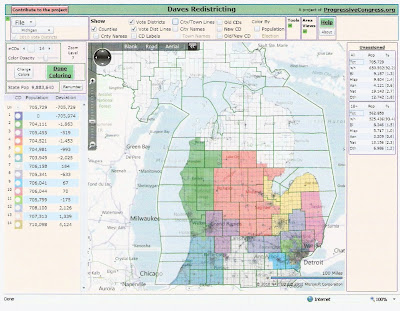
I have drawn two different maps for how these goals might be accomplished. The first could be called the “max Republican” plan, since the primary goal is too elect as many Republicans as possible and it is only secondarily concerned with maintaining the existing constituencies of Republican incumbents. It is a 9-4-1 plan, where the 1 is an open swing district.

The key to this plan is Dale Kildee’s Flint-based 5th district. It already has some Republican areas in Tuscola and south Genessee. It needs to add population, but there are no adjacent democrat areas. The solution is to excise the Republican areas plus dem-leaning south Bay so that it can add Ingham, with Shiawassee as a connector. This removes the only democrat area from Mike Rogers’ 8th district, which allows him to take on Ann Arbor.

Meanwhile, the two Detroit districts push up into the democrat areas of Oakland and Macomb. John Conyers, Sander Levin, and Gary Peters all end up in the same district. John Dingell and Hansen Clarke both have their own districts. Thaddeus McCotter would have to choose between moving to a safe district in Oakland or running in a new swing district composed of west Wayne, east Washtenaw, and Monroe.

Tim Walberg would lose Battle Creek and west Washtenaw and add Clinton, Gratiot, and Montcalm.

Here are maps, made using Dave’s Redistricting App. Note that since this program had not yet been updated with 2010 census numbers, I had to hand-add the populations for the first map. Hence they are not exact, but should be within 10,000 of the ideal size. The boundaries can be tweaked as necessary to make the populations exact.
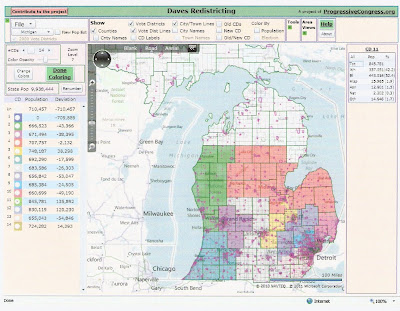
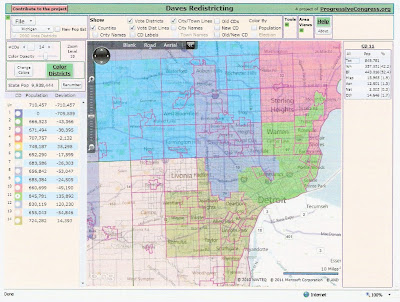
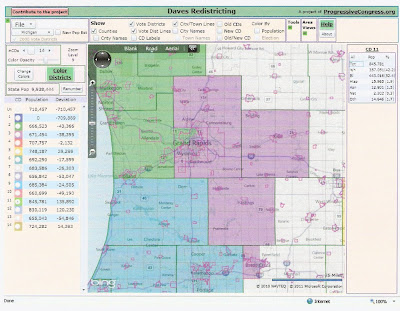
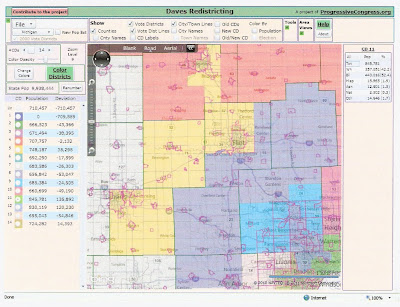

Brief Descriptions:
1. Benishek (R) Upper Peninsula, northern lower peninsula. Adds Grand Traverse, Kalkaska, Leelanau, Benzie. Loses Ogemaw, Gladwin, Arenac, north Bay.
2. Huizinga (R) West Michigan coast. Adds part of Grand Rapids. Loses north Allegan, Benzie.
3. Amash (R) Most of Kent, Ionia, Barry. Adds Battle Creek area. Loses part of Grand Rapids.
4. Camp (R) Central lower peninsula. Adds Ogemaw, Gladwin, Arenac, Bay, Tuscola, Huron, Sanilac. Loses Grand Traverse, Kalkaska, Leelanau, Montcalm, Gratiot, north Shiawassee.
5. Kildee (D) Flint area, Ingham, Shiawassee, city of Saginaw. Adds Ingham, Shiawassee. Loses Tuscola, south Bay, south Genessee.
6. Upton (R) Southwest Michigan. Adds north Allegan.
7. Walberg (R) South-central Michigan. Adds Clinton, Gratiot, Montcalm. Loses Battle Creek, west Washtenaw.
8. Rogers (R) Livington, Lapeer, north Oakland, south Genessee, Ann Arbor. Adds Lapeer, south Genessee, Ann Arbor. Loses Ingham, Clinton, south Shiawassee.
9. Open or McCotter (R) Southwest and east-central Oakland.
10. Miller (R) North Macomb, St. Clair. Adds St. Clair Shores, south Sterling Heights, part of Clinton Twp. Loses Huron, Sanilac, Lapeer.
11. Clarke (D) east Detroit, south Macomb. Adds south Macomb. Loses some of Downriver.
12. Conyers, Levin, Peters (D) west Detroit, southeast Oakland, including Pontiac, Southfield, and Royal Oak.
13. Open or McCotter (swing) west Wayne, east Washtenaw, and Monroe.
14. Dingell (D) Central Wayne, including Downriver, Dearborn, Westland. Adds Downriver, Westland. Loses Monroe, Ann Arbor.

The upsides of this map include a potential 10-4 delegation and eliminating two of Conyers, Levin, and Peters. The downside is that Camp, Rogers, and McCotter may not be very happy with how their districts are changed.

Now we consider a second plan. This could be called an incumbent protection plan, in that all the incumbents get safe districts, except that Peters and Levin are merged into one district. (Also, Walberg is not quite as safe as I would like.) This would create a 9-5 delegation.
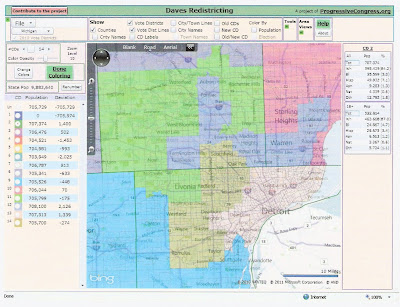

Descriptions:
1. Almost same
2. Almost same
3. Almost same
4. Camp. Adds Clinton, south Shiawassee, Gladwin, Arenac. Loses Grand Traverse, Kalkaska, Leelanau.
5. Kildee. Genessee, Bay, Tuscola, Huron, city of Saginaw. Adds north Bay, Huron.
6. Same
7. Walberg. Adds Monroe. Loses Battle Creek area, central Washtenaw.
8. Rogers. Adds Lapeer. Loses Clinton, south Shiawassee.
9. Dingell (renumbered from 15) Adds west Wayne, part of Downriver. Loses Monroe, central Wayne.
10. Miller. Adds St. Clair Shores, south Sterling Heights. Loses Huron, Lapeer.
11. McCotter. Adds Waterford, West Bloomfield, Rochester, Troy. Loses Redford, Westland, Canton.
12. Levin/Peters. South Macomb, Royal Oak, Pontiac, Bloomfield, Farmington.
13. Clarke. East Detroit. Adds Dearborn, central Detroit.
14. Conyers. West Detroit, Southfield, Oak Park, Westland, Romulus, Taylor. All but Detroit are additions. Loses part of Downriver.

Which map do you prefer?

Friday, March 25, 2011

State Shutters Stadium Speed Trap

Hooray! MDOT has decided to raise the speed limit on Stadium Drive from 40 to 45.

Speed limit on Stadium Drive to be raised; MDOT to hold public meeting to explain increase

It should really be 50, but this is a major improvement. A previous Gazette report showed that Stadium was one of the biggest speed traps in Kalamazoo. This is a sign of a speed limit that is too low.

Good for Rick Jones
Government Does Something Right!

Tuesday, March 22, 2011

Census Shocker

Preliminary census numbers for Michigan are coming out today.

Census shocker: Detroit's population falls to 713,000
Interactive map: 2010 Census information, by state

Michigan's population was earlier announced to be 9883640, down .6% from 2000.

This means that the ideal district sizes are
Congress: 705,974
State senate: 260,096
State house: 89,851

The new number coming out...
Detroit: 713,777, down 25.3% from 952047.

— Oakland County saw its population grow from 1,194,196 to 1,202,362. [up .6%]
— Wayne County's dropped from 2,061,162 to 1,820,584. [down 11.7%]
— Macomb County's population grew from 788,149 to 840,978. [up 6.7%]
— Livingston County's population grew from 156,951 to 180,967. [up 15.3%]

The size of Detroit's population loss is shocking and deserves more detailed analysis later.

Implications. Detroit has fallen so much that it may be hard to draw two black-majority congressional districts, even if they extend outside Wayne County. I don't think there is precedent for losing a black-majority congressional district.

Wayne County will lose a full state senate district, dropping from 8 t0 7. That loss will be almost entirely in Detroit. Drawing five black-majority districts will be impossible, and even four may be tricky. That district will move somewhere else in the state, and the map will have to be considerably reshuffled to accommodate it.

Wayne County will lose three state house districts, at least two coming from Detroit. It will drop from 23 to 20. Three districts will move elsewhere in the state. One will probably end up in Macomb County, one in the Livingston/Washtenaw area, and one in the Kent/Ottowa area. At least two of these should be gains for Republicans.

Genessee County: down to 425790 from 436141. It will have fewer than the current five state house districts since it falls below the minimum threshold. Flint likely accounts for most of this loss.

Kalamazoo County: up to 250331 from 238603. Kalamazoo County will likely be its own state senate district, now that it is above the minimum threshold. This could be trouble for state senator Tonya Schuitmaker, who represents all of Kalamazoo but lives in VanBuren.

More later...

Sunday, March 06, 2011

POLITICAL UPDATE--Unions

This update focuses on unions.

Michelle Malkin: Teachers’ Unions 101: "A" Is For "Agitation"
Pat Buchanan: Why Wisconsin’s Scott Walker Must Win
Ann Coulter: Uncivil Unions
Ann Coulter: Look For the Union Fable
Michelle Malkin: Fleebaggers: The New Cut-and-Run Democrats
Pat Buchanan: Barack Hussein Alinsky
Gary North: Is the Teacher's Union as Dead as a Doornail?
Michelle Malkin: Apocalypse Now: Wisconsin vs. Big Labor

POLITICAL UPDATES are archived here.

Hooray for Wyoming!

Wyoming will become the fourth state to allow carrying guns without a permit. The bill passed the legislature overwhelmingly and was signed by the governor. The other three states that allow 'constitutional carry' are Vermont, Alaska, and Arizona.

Friday, March 04, 2011

The Plight of the Democrat

Roll Call has what passes for a sob story in Washington. Michigan democrat congressmen who have been in office longer than most dictators are upset that Republicans control redistricting in Michigan.

Michigan Democrats Weary Over Redistricting

Just who are we talking about?

Congressman Age Years in Office
John Dingell....84...56
John Conyers...81...47
Dale Kildee.....81...35
Sander Levin...79...29

Just for comparison...

Dictator............ Age Years in Office
Fidel (Raul) Castro..85...51
Muammar Gadafi....68...41
Qaboos................70...40
Khalifa Al Khalifa.....75...39

What would they do if they weren't if office? They'd probably starve to death!

These four pillars of statesmanship are about to see their super-safe districts change shape. How can this be allowed to happen?? Oh, the humanity!!!

One of the downsides of gerrymandering is that it creates a few very safe districts for the other side. Ten years ago, Michigan Republicans figured that if these gerontocrats weren't going anywhere, they might as well represent as many democrats as possible. The fact is, the only time that these four face a competitive election is (maybe) once every ten years.

The Roll Call article never bothers to mention that the reason that democrats in southeast Michigan keep going through 'tough redistrictings' is that the region keeps losing population--often in absolute terms and certainly relative to the rest of the United States. Might this have something to do with the policies that they have advocated over the last 50 years?

The most likely outcome of redistricting this year is for Sander Levin and Gary Peters to end up in the same district. Who would win a battle between them would depend on how much of their current districts end up in the new district.

It's likely that John Dingell will be telling young whippersnappers in Congress about the Eisenhower administration for years to come.

Fewer County Commissioners

Redistricting also occurs at the county commission level. Redrawing county commission lines in controlled by a five-member board consisting of the County Prosecutor, Treasurer, Clerk, and chairmen of the Chairmen of the local Republican and democrat parties. In Kalamazoo County, that would be Jeff Fink, Mary Balkema, Tim Snow, Al Heilman, and Dave Pawlowski. The first four are Republicans.

In addition to the usual changes, the board can change the number of county commissioners. There are 17 at present, which was increased from 9 in 2001. The current board seems likely to reduce this number.

Reapportionment committee agrees 17 is too many members for Kalamazoo County Board

The census bureau has been releasing detailed population data state by state for the past month. Michigan's data hasn't been released yet.

Hadley: Hispanics are Restless

Kalamazoo police chief Jeff Hadley is upset.

Kalamazoo Public Safety Chief Jeff Hadley concerned he wasn't aware of immigration raids
Immigration enforcement agents arrest 20 in raids of Kalamazoo-area homes, restaurants and businesses

The feds caught a few illegal aliens without his knowledge. It turns out the DPS was informed, but Hadley didn't know until after the fact.

Hadley's concern:

“It concerns me,” Hadley said of not being made aware of the operation. “We have a (Hispanic) community here that is going to be restless. And we want to give them the best and most accurate information to calm some of their fears. I wasn’t given that information.”
Hadley seems to be more interested in calming fears than catching illegals. Two years ago, he declared Kalamazoo to be a de facto sanctuary city.

Kalamazoo to become Sanctuary City

Hadley refuses to share information about illegal aliens with the feds, but he gets upset when he doesn't get information from them.

Sunday, February 27, 2011

Republican Michigander on the CFM Redistricting 'Study'

Republican Michigander takes a look at the Center for Michigan redistricting 'study' that this blog previously dismantled.

Michigan Redistricting 2011-2012 (and a close look at Center For Michigan/Argus claims)

He shows that Michigan's legislative districts are far more competitive than the 'study' claims due to its misleading definition.

Previous:
Analysis and Rebuttal of the Center for Michigan Redistricting Study
The Center for Michigan Redistricting 'Study' Has Data Errors, Too

Wednesday, February 23, 2011

Hooray for Comstock

Congratulations to Comstock voters for once again defeating a millage renewal.

Comstock school district voters reject 2.5-mill tax renewal, 633-689

Tuesday, February 22, 2011

Are You Offended Yet?

It has been five years since the WMU College Republicans brought Ann Coulter to speak on campus. The speech had over 2000 people in attendance. Our flyers asking "Ann Coulter is coming to WMU... Are you offended yet?" seemed to really bug liberals.

Check out the February 2006 Archives for our posts about the event both before and after.

Saturday, February 19, 2011

POLITICAL UPDATE--The Economy

This update focuses on the economy.

Gary North: I'm So Glad I Was Fired – Twice
Gary North: The Fed vs. Widows
Gary North: The End of the Nation State
Phyllis Schlafly: Obama's Plan to Admit Mexican Trucks
Gary North: The Nation State Is Doomed
Gary North: I'm Thankful for Shopping Malls

See also:
Gary North series: What is Money?
The Recession Reader
The Bailout Reader

The Center for Michigan Redistricting 'Study' Has Data Errors, Too

This blog previously deconstructed the Center for Michigan study.

Analysis and Rebuttal of the Center for Michigan Redistricting Study

I was looking over the data used to construct this report and noticed several errors. Two state house districts are classified as safe when they in fact changed parties. Three others are listed as changing parties once, when they in fact switched twice.

The specific errors are:

District Error .. Truth
24 Usually GOP Swing
32 Usually GOP Swing
70 Safe GOP .. Swing
108 Usually GOP Swing
110 Safe DEM .. Usually DEM

Curiously, all of the errors favor less competitiveness.

Wednesday, February 16, 2011

POLITICAL UPDATE--Immigration

This update focuses on immigration.

Washington Watcher: CPAC: Conservatives Pandering—Aliens (Still) Coming
Steve Sailer: Byron Roth’s The Perils Of Diversity: Apologies To The Grandchildren
Phyllis Schlafly: Detaching the Anchor from Anchor Babies
Victor Davis Hanson: Two Californias
James Fulford: The Fulford File: Dubya Memoir Shows He Never Understood Immigration (Although His Nanny May Have)
Roger Hedgecock: DREAM Act: An Amnesty Nightmare

For more on immigration, see VDARE.com.

2011 Election Preview

This article was last updated November 20, 2012.

Michigan will saw several elections in 2011. This was a preview of elections in Michigan and Kalamazoo County. Elections earlier this year are summarized below.

Kalamazoo-area Election Guide 2011

November 8

This is the day for local city elections.

Kalamazoo City Commission

All seven seats on the Kalamazoo County Commission were up for election. The seven commissioners are Mayor Bobby Hopewell, Vice-mayor Hannah McKinney, Don Cooney, David Anderson, Barb Miller, Stephanie [Moore] Bell, and Robert Cinabro. Cinabro was appointed to replace Terry Kuseske, who died mid-term.

Cinabro ran for a full term, and all the other incumbents sought reelection. Challengers Nicholas Boyd, Antwon Hunter, Robert Patterson, Michael Perrin, Nicholas Wikar, and Andrew Worden also ran. Perrin and Worden ran as fiscal conservatives. Boyd was an unsucessful candidate in 2009. Boyd and Wikar were endorsed by the Kalamazoo Chamber of Commerce over Cooney and Moore/Bell. All of the incumbents were reelected.
See who filed Tuesday to run in the Nov. 8, 2011 election for local government positions in Southwest Michigan

There was a proposal on the ballot to decriminalize marijuana by making it the "lowest possible enforcement priority". This would not have much practical effect, though. The ordinance passed overwhelmingly, winning every precinct.

Portage City Council

The mayor of Portage, Peter Strazdas, ran for reelection. Three of the six seats on the commission were also up for election. Those seats are held by Cory Bailes, Patricia Randall, and Elizabeth Campbell. Cory Bailes was appointed to replace Margaret O'Brien, who was elected state representative. Randall was elected to a two year term, succeeding Ted Vliek, who was appointed to fill the vacancy left when Larry DeShazor was elected state representative.

Reed ran for reelection and Bailes and Randall ran for full terms. Jim Pearson, a planning committee member who lost to Randall in 2009, sought a seat. The Kalamazoo Chamber of Commerce endorsed everyone except Randall. Campbell, Pearson, and Randall won the three seats.

Mattawan School District

The district voted on a 59 million dollar bond measure after voting down an 88 million dollar tax increase in May. The millage was defeated for a second time.
Mattawan going back to voters for $59M for new elementary schools

February 22

This is one of four yearly election days in Michigan. The only jurisdiction with an election locally was Comstock Schools, which sought a millage renewal. It was rejected.

Comstock voters to decide 2.5-mill tax renewal

May 3

This is the date for school board elections. Kalamazoo, Portage, and Gull Lake all have contested races. There are also various millages on the ballot.
Election Results

Tax questions appearing on the May ballot include new library in Paw Paw, renovating South Haven high school, township millage renewals
7 candidates running for school board in Kalamazoo; 5 in Portage
Complete list of area school board candidates.
Complete list of library board candidates.

KRESA Millage. This is a renewal of a "temporary" millage that affects all the Kalamazoo County-based school districts. It is funnelled through KRESA to the districts to avoid limitations on the amount of taxes that districts can levy. It was billed in 2005 as a "one-time tax". In 2008, it was sold as a renewal of an existing tax. This passed roughly 2:1.

Stop the KRESA Tax

Kalamazoo. There were five candidates for two seats. Incumbent trustees Liz Henderson and Eric Breisach are retiring. The candidates are Demarra D. Gardner, Jennie Hill, Lissette Mira-Amaya, Jennifer Pollard, and Mark Totten. Totten is the best-known, having spent a small fortune in a losing bid for the democrat nomination for state senate in 2010. Totten and Hill won the two seats.

Portage. There were five candidates for two seats. Board President Kevin Hollenbeck and Vice-President Melanie Kurdys are running for full terms. Hollenbeck was appointed to a partial term following a resignation. Also running are Tom Eddy, Ted Hartridge, and Kevin Hoffer. The board has been divided over the issue of the status of Superintendent Marcia Wells. According to the Gazette, "Eddy is a former school trustee who was on the board that hired Wells; Hoffer is a Portage parent who has been critical of administration, and Hartridge attended a recent board meeting in support of Wells." Eddy and Hartridge were elected.

Kurdys and Hollenbeck for Portage School Board

Gull Lake. There are four candidates for two seats. They are Laura Burr, Loyal Eldridge II, Paul J. Foust, and Lorence R. Wenke. The best-known is Wenke, who was a three-term Republican state representative who lost a 2010 primary for state senate. Burr and Eldridge were elected.

The Kalamazoo library board race is uncontested, while there are six candidates for four spots in Portage. Betty Ongley, who held many positions in Portage over the years is the best known.

August 2

There was nothing on the ballot in Kalamazoo County for this election.

Saturday, February 12, 2011

Blogiversary

It has been five years since this blog began. We have had 1844 posts. This began as a group blog for the Western Michigan University College Republicans and has since transitioned to an individual blog by one of Western's graduates.

The highlights of five years' of content can be found on the sidebar at right.

Analysis and Rebuttal of the Center for Michigan Redistricting Study

The Center for Michigan, a liberal, pseudo-centrist think tank in Ann Arbor, recently published a 'study' attacking the redistricting process in Michigan.

REDRAWING MICHIGAN
How redistricting predetermines many election results and often leaves voters without competitive choices at the polls


The report is cowritten by Susan Demas and John Bebow. Demas is a liberal reporter and blogger.

The 'study' argues that
1. Michigan legislative elections are uncompetitive.
2. This is due to redistricting, particularly the 2001 plan passed by Republicans.
3. This lack of competitiveness 'disenfranchises' Michigan voters.
4. Michigan's legislative districts should be drawn to create more 'competitive' districts.

ANALYSIS AND REBUTTAL

3. The third point is the easiest to deal with. The authors are misusing the word disenfranchise, which means to take away the ability to vote. Losing an election does not mean you were disenfranchised.

Note however that if we were to accept this false definition of disenfranchisement, that competitive districts would 'disenfranchise' more voters than noncompetitive ones, since in a competitive district, almost half the voters will see their candidate lose each time. Most voters get their way when districts are not competitive.

1. Are Michigan legislative elections competitive? It depends what you mean by competitive. It is certainly true that in many elections, the outcome is not really in doubt. However, the standard used by the 'study' is dubious. They switch between competitive, by which they seem to mean 'has switched parties in the last decade' and 'swing district', meaning 'they either regularly changed hands between the parties or averaged a 3-percent margin or less over the past decade'.

They point out that 25 of 110 state house seats switched parties in the past decade. That sounds pretty competitive to me, given the relatively small number of voters who switch parties even between wave elections. How many districts should have switched? 50? 100? The 'study' doesn't say. If the map is so gerrymandered, why did any seats switch?

Their standard is flawed because it does not account for the fact that which districts are competitive changes from election to election. A seat that may be perfectly competitive on paper may not be so in a given year when it has a popular incumbent running for reelection. Which seats are competitive also depends on swings in public sentiment.

For example, the 61st house district had highly competitive elections in 2006 and 2008, narrowly won by Republicans. In 2010, the public swung to the right and the Republican won by 25 points. In the 20th senate district, there have been three hotly contested elections with the last two seeing a million dollars or so spent. All three were won by the Republican (2006 very narrowly). Both districts are listed as not competitive by CFM. Someone should have told the candidates.

The report doesn't make clear whether their standard for swing districts averages margins or vote percentages. For example, if a district swings from 55%R-45%D to 45%R-55%D, is the average 10% or 0%?

2. Is the lack of competitiveness, such as it is, due to redistricting? If voters were randomly distributed geographically, we would expect to see most areas nearly even in political preferences. But voters are not randomly distributed, they choose where they live. People tend to live near people who are demographically similar to themselves. This is true for income, class, race, and to a lesser extent age. Political preferences are correlated with all these factors to some extent. Thus the distribution of voters is not random. Evenly divided areas are the exception, not the rule.

It is true that gerrymandering can exacerbate lack of competitiveness due to geography. For example, only one of California's 53 congressional districts switched parties in the past decade. This is due to an extreme gerrymandering plan. But this is nothing like what exists in Michigan. The number of swing districts is hardly out of line with geography in Michigan.

2001 State House Districts - MICHIGAN S 110 HOUSE DISTRICTS

Consider the state house. Does the map appear gerrymandered? (No.) The districts are compact and follow county and city lines when possible. If the map were so heavily gerrymandered, why did democrats win the state house in 2006 and 2008? Now, there is a slight Republican lean to the map, but it would take a political expert to demonstrate this.

There were five state house elections over the past decade, so even in the era of term limits, most districts had two or three representatives. Since incumbents rarely lose, there weren't that many chances for districts to flip.

2001 State Senate Districts - Michigan.gov

The state senate districts also are compact and follow county and city lines as much as possible. The strangely shaped districts are in Detroit, which are designed to create black-majority districts, not for partisan advantage. The map leans more Republican than the state house map, but again the effect is subtle.

There were only three state senate elections over the past decade and each district has had two senators over that time. Republicans had good years when there were many open seats in 2002 and 2010, and were fortunate to have many incumbents in the bad year of 2006.

In support of their argument, the authors cite the fact that the percentage of seats won by Republicans exceeds the percentage of the aggregate vote that they receive. They blame this on redistricting. But there is a simple geographic explanation for this: Detroit. Most districts in Detroit are 95% democrat. This has the effect of concentrating many democrats in these districts and diluting them elsewhere. There is no comparable concentration of Republicans in the state. The most Republican district in the state (Holland area) is probably around 80% Republican, and few are more than 70% Republican.

There is a simple test for the authors' claim that redistricting causes lack of competitiveness. Seats that cannot be redrawn ought to be significantly more competitive. Consider statewide elections.

President. Michigan has gone democrat each of the last five presidential elections (it went Republican each of the five before that). Most of these elections were not close.

Governor. The governorship changed parties in 2002 and 2010. The 2002 election was fairly close (4%) while 2006 and 2010 were blowouts for opposite parties. (The 1994 and 1998 elections were also blowouts.)

Senate. Carl Levin has been elected to six consecutive terms (36 years), usually by large margins. Debbie Stabenow has been elected to two terms (12 years), succeeding a Republican.

Secretary of State. Republicans have won the last five elections by significant margins. Democrat Richard Austin held the seat for the preceding 24 years.

Attorney General. Republicans have won the last three elections (2002 was close). Before democrat Jennifer Granholm's one term, the seat was held by 'Eternal General' Frank Kelley for 38 years.

None of these seats, except possibly the governorship, would be considered competitive by the standard employed by the Center for Michigan. Apparently the state of Michigan is simultaneously safe for both democrats and Republicans depending on the seat in question!

Similar results hold on the county level. For example, Kalamazoo County is usually considered to be a swing area. But democrats have won the last five presidential races in the county. Democrats won governorship in the county in 2002 and 2006 and lost in 2010. Republicans won the last five secretary of state races and last three attorney general races in the county. The state senate district including Kalamazoo County has voted Republican for 50+ years. The prosecutor, clerk, treasurer, and surveyor have similarly been held by the GOP for many decades. A similar string in the Sheriff's office was broken in 2008. Only the drain commissioner could be considered competitive by the CFM's standard, switching parties each of the last three elections.

Obviously gerrymandering cannot account for this. Incumbency and the particular nature of these offices provide better explanations.

4. The report is somewhat vague with regard to recommendations. It suggests that there be more transparency. But as the report correctly notes, average voters don't care about redistricting, so this is unlikely to have much impact.

The report also speaks favorably of an 'independent commission' to draw districts. But such commissions cannot remove politics from an inherently political process. Such commissions have sometimes produced highly partisan gerrymandered maps, as in New Jersey. Others consistently deadlock and send the issue to the courts. Such commissions are accountable to absolutely nobody for their decisions.

The report also seems to suggest drawing a map to create more competitive seats. But as we have seen, geography guarantees that most areas are not politically evenly divided. To artificially create more 'competitive' seats would require extreme gerrymandering, ignoring county and city boundaries.

And why should 'competitive' districts be favored, anyways? Are substantive outcomes better for Michigan citizens. The report includes one quote that basically undermines its entire premise.

Brittany Galisdorfer, Earhart fellow with the nonpartisan Citizens Research Council, notes that academic research has been inconclusive about the effects of more competitive seats.

"The general theory is that competitive districts mean less extreme political candidates, less political partisanship and ensure basic fairness," she said. "But there’s no consensus that those things actually occur."
CONCLUSION

There is no question that redistricting is an inherently political process and that the sausage-making process is not always a pretty sight. But the Center for Michigan's critique of the redistricting process is fatally flawed. It uses a skewed standard for competitiveness for that virtually guarantees its conclusion. This standard leads to the absurd result that different seats in the same jurisdiction can simultaneously be considered 'safe' for opposite parties.

It incorrectly blames lack of competitiveness on redistricting. Instead, geography is the biggest explanation for lack of inherent competitiveness and the role of redistricting is exaggerated. The biggest reason for lack of competitiveness in specific elections is incumbency. Most seats that flip do so when they are open, and this most often happens due to term limits. Ironically, the Center for Michigan opposes current term limits.

It blatantly misuses the term 'disenfranchise' to sensationalize the issue. The 'reforms' that it favorable recommends would not help and could easily make things worse.

Whether the Center for Michigan's report is sincere or merely an attempt to impede Republicans in the redistricting process, its poor reasoning and misleading use of statistics do not deserve to influence public debate.

Friday, February 11, 2011

Upton Votes Conservative--Thanks, Jack!

The American Conservative Union released its ratings of Congress in 2010. Congressman Fred Upton scored 92% conservative. His only negative votes were supporting extension of unemployment benefits.

What could have caused Upton's right turn, just two years after his anemic 44% conservative record? Could it be the primary challenge from Jack Hoogendyk, who won an impressive 43% of the vote against Upton on a shoestring budget?

Upton's 2002 rating ties his 2002 rating for his best ever. What happened in 2002? Upton's last primary challenge.

2010 House Ratings
Fred Upton's Conservative Ratings

Sunday, February 06, 2011

Reagan Forever

Today marks the 100th anniversary of the birth of Ronald Reagan. Reagan was the greatest President of the 20th century, and possibly ever.

His accomplishments speak for themselves.
  • He liberated 300 million or so people from communist tyranny and ended the Cold War without firing a shot.
  • He ended the disastrous stagflation of the 1970s and set the stage for 25 years of economic growth.
  • He pushed through a major tax cut, rolled back regulations, and cut government spending as a proportion of GDP.
  • He rebuilt the American military.
  • He revived the American spirit.
Reagan was a committed conservative and leader of the conservative movement in the 1970s and 80s. He did what he could to advance conservatism from appointing Antonin Scalia to the Supreme Court to ending the fairness doctrine, leading to the rise of talk radio.

Liberals hated him then and try to misrepresent him now. He was right and they were wrong.

Those of us too young to remember much of his presidency got a taste of Reagan's America in 2004 upon his death when for one glorious week liberals had to shut up while we celebrated Reagan and what he stood for.

Reagan remains incredibly applicable today. Listening to his classic A Time for Choosing speech from 1964, for example, is amazingly prescient about the issues we still face.

A Time for Choosing

Wednesday, February 02, 2011

Democrat Supervisor Doesn't Pay Taxes

What's democrat Kalamazoo Township Supervisor Terri Mellinger been up to?

Kalamazoo Township supervisor hasn't paid property taxes since 2007; but Terri Mellinger pledges to catch up

KALAMAZOO TOWNSHIP — A Kalamazoo Township home belonging to the township supervisor and her husband could be one of hundreds that become property of Kalamazoo County by the end of March.

Terri Mellinger’s property in the Westwood neighborhood is among more than 850 properties that owe 2008 property taxes and will be foreclosed on by the county treasurer after March 31. A list of all the properties owing 2008 property taxes was published in the Kalamazoo Gazette this month.

But Mellinger, who was elected Kalamazoo Township supervisor in 2008 and makes about $72,000 a year, said she has every intention of paying the back taxes, which with fees and interest totals $5,426.07 for 2008.
At least she was up front about it...

She said she’s informed several township officials about the delinquent taxes. She also informed the Kalamazoo County Democratic Party when she filed to run for township supervisor.

“It's not something that I've hidden,” she said.
Did she inform the voters?

Commenter 'kzooresident' points out some relevant facts.

Please keep in mind that this is the same lady that had the township illegally collect a millage renewal that it was not supposed to. When I confronted her on the legality of collecting the taxes (that had expired and were not renewed when the collected), her response was simple...."go ahead and sue us for it....we've already spent the money, and there's no way we can pay everyone back. Sorry for the problem".

Wow what a statement and example of leadership. Amazing how politicians and bureaucrats have no problem collecting YOUR money, but when it comes to them they always feel that they are above the law. Seriously blaming this on the mortgage provider? Are you kidding me? Trust me the one thing mortgage servicers do is pay the taxes/insurance. They have to. I'm not buying that for one second.

I for one hope that she loses her house because of this. Kharma is a bitch, and it always comes back to bite you.
Mellinger was the handpicked candidate of the local democrat party in 2008.

And Mellinger said she hopes her constituency — some of whom may be struggling with job loss, home foreclosure, mounting medical bills — will be understanding.
Mellinger should read Matthew 18.

Snyder Appoints Democrat WMU Trustee

Who did our new governor Rick Snyder appoint to the WMU Board of Trustees?

Gov. Rick Snyder re-appoints Ken Miller to Western Michigan University's board, also appoints Dana Debel

KALAMAZOO — Gov. Rick Snyder re-appointed Western Michigan University Trustee Ken Miller on Tuesday to another eight-year term on the university’s governing board.
Miller is the businessman who is behind the push for a downtown arena financed by taxpayers, supposedly for 'economic development'. It's no shock that Snyder would like him.

No Arena, for Now
Dome of Deceit
Arena of Conflict
Forum of Discontent

Who else did Snyder appoint?

Snyder also appointed Dana Debel of Ann Arbor.

Debel, 33, replaces William Martin, who served a single eight-year term.

Debel is the director of state and local government affairs for Delta Air Lines and holds a bachelor’s degree and a master’s degree from Michigan State University. She once worked as a policy adviser to former Gov. Jennifer Granholm.

Debel named WMU trustee, Miller reappointed

Director of state and local government affairs for Delta Air Lines, Debel previously served as a policy director for former Gov. Jennifer Granholm from 2003 to 2007, primarily in the areas of environmental and energy policy. She earned both a bachelor's degree in environmental studies and a Master of Business Administration from Michigan State University.
So Debel is a lobbyist who didn't go to Western and isn't a Republican. She also lives in Ann Arbor, not Kalamazoo. So why exactly did Snyder appoint her?

It's one thing for Snyder to appoint democrats like Andy Dillon to positions in the executive branch, where they can be told what to do and replaced if necessary. Appointing a democrat to an eight-year term on a university board is quite another. Western's board desperately needs some local Republicans after eight years of Granholm appointees. Debel's appointment is inexcusable.

Sunday, January 23, 2011

POLITICAL UPDATE--Liberalism

This update focuses on liberalism.

Ann Coulter: Mud Libel
Ann Coulter: Scrooge Was A Liberal
Dan Flynn: Want To Understand The Left?
Dan Flynn: Socialism Didn't Work at Plymouth Plantation, Either
Michelle Malkin: Ray LaHood: Obama's Power-Mad Cell Phone Czar
Phyllis Schlafly: Obama Pleads for Women's Vote

Much information on liberal individuals and organizations can be found at David Horowitz's Discover the Network site.

Sunday, January 16, 2011

POLITICAL UPDATE--Leftist Violence

This update focuses on leftist violence in the wake of the Arizona shooting. The left is trying to suppress conservative speech in the name of civility. Most political violence comes from the left, not the right.

Michelle Malkin: The progressive “climate of hate:” An illustrated primer, 2000-2010
Michelle Malkin: Blame Righty: A Condensed History
Dan Flynn: The Left's History Of Violence
Pat Buchanan: Poisonous Politics
Ann Coulter: Liberal Seek Ban on Metaphors In Wake of Arizona Shooting

POLITICAL UPDATES are archived here.

Friday, December 31, 2010

The Best of The Western Right: 2010

This blog has been busy this year, covering many topics. We had 300 posts this year. Here are some of the best posts of 2010.

Conservative of the Year: Jim DeMint
National Redistricting Preview
National Conservatives Finally Notice Fred Upton

Analysis: Governor
Analysis: Michigan
Analysis: Kalamazoo

Weaver's Betrayal
The Politically Incorrect Guide to the Founding Fa...
Arguing With Idiots
Analysis of the 20th Senate Primary
Money on Fire
Analysis of 6th District Congressional Race
Jack Hoogendyk for Congress
The Case Against Rick Snyder
Fred Upton's Ten Worst Votes
Fred Upton's Jobs Plan
Who is Grant Taylor?
We Are Doomed
Mike Cox for Governor
Evaluating the Candidates for Governor
Who Killed the Constitution?
The Conscience of a Conservative
Michigan Senate Races
Area State House Races
Hoekstra: Who, Me?
Kalamazoo County Commission Races
Upton on Immigration
Rejecting the Arena
Stand With Arizona
No Arena, for Now
Wrongest Statement Ever in the Herald?
Real Conservative Candidates
Hoekstra on the Bailout
Census Lies
Dave Pawlowski is a Bad Person
Democrats Attack Local Business, Try to Put People Out of Work
Democrats Lie About Margaret
The New Case Against Immigration
2010 Election Preview

Previous:
The Best of The Western Right: 2009
The Best of The Western Right: 2008
The Best of The Western Right: 2007
The Best of The Western Right: 2006

Best Articles of 2010

It is time for the best articles of 2010. These articles were selected from roughly 10,000 articles this year. More than 400 articles appeared in this year's 52 POLITICAL UPDATES.

The culture war was the most frequent topic, inspiring eight updates. Immigration and government were tied with seven. Fourth was the economy with six.

This year there was a clear choice for the best article of the year.

Angelo Codevilla: America's Ruling Class – And the Perils of Revolution

Following this, in chronological order, are twelve more selections for the most important news or opinion pieces of 2010.

Gary North: A Red-Alert Threat to the Regime
Steve Sailer: “Bad Students”—Unmentionable Cause Of The Great Achievement Gap
Gary North: Bring Down the Ruling Elite
Ann Coulter: Justice Brennan's Footnote Gave Us Anchor Babies
National Review: Ten Reasons to Oppose Dodd-Frank
Gary North: Abolish the Public Schools
John Taylor Gatto: Against Schools
Steve Sailer: MSM Buries Lead—American Majority Supports Arizona Law. But Our Elites Don’t Like The American Majority
Gary North: Read All About It! The NY Times and Other Establishments Sheets Are Dead
Allen Wall: Yes, La Raza Really Does Mean "The Race"—And The Idea Was Invented By a Nazi Sympathizer
Gary North: The City of Detroit is Dead: It Was Killed by Government
Steve Sailer: Hidden Key To Last Decade’s Disasters: Dubya’s Commitment To “Diversity”

Previous:
Best Articles of 2009
Best Articles of 2008
Best Articles of 2007
Best Articles of 2006
Best Articles of 2005

Thursday, December 30, 2010

2010: The Year at Western

2010 was a fairly quiet year at Western, at least politically. Neither the College Republicans or the various leftist groups on campus made much noise.

Preparations continued all year for a privately funded medical school at Western. An interim dean was appointed and candidates for dean were interviewed.

A bill was introduced in the state house to eliminate the last elements of the Baptist heritage of Kalamazoo College. It passed the state house but was not taken up by the state senate.
The Betrayal of Kalamazoo College

President Dunn suffered a mild heart attack. Governor Granholm signed the bill to expand a business park into Colony Farm Orchard.
Local News

The local Tea Party group had a town hall at Western on health care.
Health Care Town Hall

The Herald was very, very wrong about the WSA.
Wrongest Statement Ever in the Herald?

The few Western students who voted supported the sustainability fee proposal.
Another Green Scam

Never forget America First Day.

There was some sort of controversy over the WSA presidential election.
Local News

A Western student was sued by a local towing company after criticizing its dubious business practices on Facebook. The lawsuit was dropped in December.
Local News

WMU College Republicans Endorse Margaret O'Brien

Western reached a contract agreement with the part-time employees union.

What does the MSA stand for?
Muslim Students Association

Earthquake at WMU

The Board of Trustees approved a 7.4% increase in tuition.
Local News

A local professor wants to talk about race, then calls people racist if they disagree with her.
Local News

This blog defended, then graduated, hopefully for the last time.
Piled Higher and Deeper
Congratulations, Graduates!

Western began construction on the new Sangren Hall despite only having secured part of the funding from the state. Further funding fell through in the legislature, and Western threatened to raise tuition by 3% to compensate.

Previous:
2009: The Year at Western
2008: The Year at Western
2007: The Year at Western
2006: The Year at Western

Conservative of the Year: Jim DeMint

2010 was unquestionably the year of the Tea Party. Begun in 2009, and drawing from the Ron Paul campaign of 2007-8, the movement went from nothing to rocking Washington in a short time. The conservative movement and Republican party, pronounced dead by some in the wake of the 2008 election are back and in some ways, stronger then ever.

The Tea Party is what conservatives have always needed--a genuine grassroots movement. The movement is leaderless and so cannot be easily corrupted.

Even before winning elections, the Tea Party had a significant impact in Washington. They made democrats pay dearly for passing Obamacare and are keeping up the pressure for repeal. They made cap-and-trade and card check dead in the water. They defeated the omnibus spending bill and the DREAM act.

Unlike previous conservative movements, the Tea Party does not view voting Republican as The Answer. Thus they mounted primary challenges to a slew of unconservative Republicans and defeated Bob Bennett at a convention, Lisa Murkowski in a primary (though not the general), and Bob Inglis in a primary. Arlen Specter and Charlie Crist fled the party rather than face challenges, and both lost. Moderate Mike Castle was denied a Senate nomination. These and a slew of other unsuccessful primary challenges made it clear that congressional Republicans had better shape up or ship out, and that 'the lesser of two evils' was not good enough. Thus even unsuccessful candidates like Christine O'Donnell served a useful purpose. And to think that an early liberal lie about the Tea Party was that it was an AstroTurf creation of the Republican establishment.

The Tea Party is now busy trying to rest control of the Republican party from the establishment.

To achieve its victories, the Tea Party had to overcome one of the most vicious smear campaigns in politics. The biggest lie of course was that they are RAAACIST! depsite a shred of evidence to support this. They didn't let the lies show them down, and in November elected Allen West, Tim Scott, Marco Rubio, Brian Sandoval, Nikki Haley, and a half-dozen Hispanic Republican congressmen.

No one person represents the whole movement, of course. But a strong case can be made for Senator Jim DeMint as the predominant Tea Partier in Washington. DeMint has a long track record of fighting for conservative causes. This often means opposing his own party, as when he fought against the prescription drug bill in 2003 and amnesty in 2006 and 2007. This year, he led the fight against government spending in the Senate, sponsored Ron Paul's audit the Fed bill, and held up a slew of bad legislation.

Having earned the respect of the grassroots, he helped to elect Tea Party candidates in November. He gave early endorsements to Pat Toomey and Marco Rubio. He offered support to Rand Paul and Mike Lee. He used his PAC to send them financial support helped them to raise more on their own. Next year, he will have more staunchly conservative allies in the Senate.

For these reasons, Senator Jim DeMint is The Western Right's conservative of the year.

Honorable mentions: Glenn Beck, Ron Paul, Sarah Palin, Russell Pearce, Sam Alito, Jeff Sessions

Previous winners (including retroactive):
2009: Glenn Beck
2008: Sarah Palin
2007: Ron Paul
2006: Jerome Corsi
2005: Tom Tancredo
2004: John O'Neill
2003: Roy Moore
2002: John Ashcroft
2001: George W. Bush
2000: William Rehnquist

Wednesday, December 22, 2010

National Redistricting Preview

With the release of the 2010 census of state populations, the number of members of congress each state is allocated is now set. Next year we will see the decennial process of redistricting commence.

Redistricting 2010: Who Controls What
A Preview of 2012 Redistricting
Dave's Redistricting App

The posts above explain who controls the redistricting process in each state and what is likely to happen. The analysis is pretty good, though this blog would take issue with it in a few cases. 'Dave's Redistricting App' allows you to try your own hand at political mapmaking. This blog may post its own maps in the future.

The following table contains our projections for what will happen in redistricting. The second column says who controls the process with
R = Republican
D = democrat
S = Split control
C = 'Independent' commission

The third column gives the old number of districts for the state. The fourth column says how many are gained or lost. The fifth column gives the current (post-election) R/D split of the congressional delegation.

The final three column contain the best case, most likely, and worst case scenarios for Republicans of gains or losses due to redistricting. Note that this does not account for gains or losses for other reasons.

Note also that a state gaining or losing a seat leads to a gain or loss of half a seat. This follows the same reasoning that leads to saying that a baseball team leads its division by half a game. That is, if a democrat is eliminated in Michigan and a Republican is added in Georgia, Republicans have gained only one seat, not two.

Here is the table.

State Control #Dist. Change Now Best Likely Worst
AL ___ R ___ 7 ___ 0 ___ 6\1 ___ 0 ___ 0 ___ 0
AK ___ S ___ 1 ___ 0 ___ 1\0 ___ 0 ___ 0 ___ 0
AZ ___ C ___ 8 ___ 1 ___ 5\3 __ 1.5 __ 0.5 _ -1.5
AR ___ D ___ 4 ___ 0 ___ 3\1 ___ 0 ___ 0 __ -1
CA ___ C __ 53 ___ 0 __ 33\20 __ 5 ___ 0 ___ -5
CO ___ S ___ 7 ___ 0 ___ 4\3 ___ 1 ___ 0 ___ -1
CN ___ D ___ 5 ___ 0 ___ 0\5 ___ 0 ___ 0 ___ 0
DE ___ D ___ 1 ___ 0 ___ 0\1 ___ 0 ___ 0 ___ 0
FL ___ R __ 25 ___ 2 ___ 19\6 ___ 1 ___ 0 ___ 0
GA ___ R __ 13 ___ 1 ___ 8\5 __ 2.5 __ 1.5 __ 0.5
HI ___ D ___ 2 ___ 0 ___ 0\2 ___ 0 ___ 0 ___ 0
ID ___ C ___ 2 ___ 0 ___ 2\0 ___ 0 ___ 0 ___ 0
IL ___ D __ 19 ___ -1 __ 11\8 __ -0.5 _ -2.5 _ -3.5
IN ___ R ___ 9 ___ 0 ___ 6\3 ___ 2 ___ 1 ___ 1
IA ___ C ___ 5 ___ -1 ___ 2\3 __ 0.5 __ 0.5 _ -0.5
KS ___ R ___ 4 ___ 0 ___ 4\0 ___ 0 ___ 0 ___ 0
KY ___ S ___ 6 ___ 0 ___ 4\2 ___ 0 ___ 0 ___ 0
LA ___ S ___ 7 ___ -1 ___ 6\1 __ -0.5 _ -0.5 _ -0.5
ME ___ R ___ 2 ___ 0 ___ 0\2 ___ 1 ___ 0 ___ 0
MD ___ D ___ 8 ___ 0 ___ 2\6 ___ 0 ___ 0 ___ -1
MA ___ D __ 10 __ -1 __ 0\10 __ 0.5 __ 0.5 __ 0.5
MI ___ R ___ 15 __ -1 __ 9\6 __ 1.5 __ 0.5 ___ 0.5
MN ___ S ___ 8 ___ 0 ___ 4\4 ___ 0 ___ 0 ___ 0
MS ___ S ___ 4 ___ 0 ___ 3\1 ___ 0 ___ 0 ___ 0
MO ___ S ___ 9 __ -1 ___ 6\3 __ 0.5 __ 0.5 _ -0.5
MT ___ S ___ 1 ___ 0 ___ 1\0 ___ 0 ___ 0 ___ 0
NE ___ R ___ 3 ___ 0 ___ 3\0 ___ 0 ___ 0 ___ 0
NV ___ S ___ 3 ___ 1 ___ 2\1 __ 0.5 __ -0.5 _ -0.5
NH ___ R ___ 2 ___ 0 ___ 2\0 ___ 0 ___ 0 ___ 0
NJ ___ C ___ 13 __ -1 ___ 6\7 __ 1.5 __ 0.5 _ -0.5
NM ___ S ___ 3 ___ 0 ___ 1\2 ___ 0 ___ 0 ___ 0
NY ___ S ___ 29 __ -2 __ 8\21 ___ 0 ___ 0 ___ -1
NC ___ R ___ 13 __ 0 ___ 6\7 ___ 4 ___ 2 ___ 1
ND ___ R ___ 1 ___ 0 ___ 1\0 ___ 0 ___ 0 ___ 0
OH ___ R ___ 18 __ -2 __ 13\5 ___ 0 ___ 0 ___ -1
OK ___ R ___ 5 ___ 0 ___ 4\1 ___ 1 ___ 0 ___ 0
OR ___ S ___ 5 ___ 0 ___ 1\4 ___ 1 ___ 0 ___ 0
PA ___ R ___ 19 __ -1 __ 12\7 __ 2.5 __ 1.5 __ 0.5
RI ___ D ___ 2 ___ 0 ___ 0\2 ___ 0 ___ 0 ___ 0
SC ___ R ___ 6 ___ 1 ___ 5\1 __ 0.5 __ 0.5 __ 0.5
SD ___ R ___ 1 ___ 0 ___ 1\0 ___ 0 ___ 0 ___ 0
TN ___ R ___ 9 ___ 0 ___ 7\2 ___ 1 ___ 0 ___ 0
TX ___ R ___ 32 __ 4 ___ 23\9 __ 3 ___ 1 ___ 0
UT ___ R ___ 3 ___ 1 ___ 2\1 __ 1.5 __ 0.5 __ 0.5
VT ___ D ___ 1 ___ 0 ___ 0\1 ___ 0 ___ 0 ___ 0
VA ___ S ___ 11 ___ 0 ___ 8\3 ___ 0 ___ 0 ___ 0
WA ___ C ___ 9 ___ 1 ___ 4\5 __ 1.5 __ 0.5 _ -1.5
WV ___ D ___ 3 ___ 0 ___ 2\1 ___ 0 ___ 0 ___ -1
WI ___ R ___ 8 ___ 0 ___ 5\3 ___ 1 ___ 1 ___ 0
WY ___ R ___ 1 ___ 0 ___ 1\0 ___ 0 ___ 0 ___ 0
Total______435 ___ 0 _ 242\193 _ 35 __ 9 ___ -15

Thus our best projection is a GOP gain of nine seats, with quite a bit of variation between the best and worst case scenarios. Republicans can also shore up some vulnerable incumbents.

Michigan Loses a Seat

As expected, Michigan will lose a seat in the upcoming round of redistricting. Michigan was the only state to lose population over the past decade. It is likely that Gary Peters' district will be carved up.

Once again, all over the country people fled political jurisdictions run by liberals and moved to those run by conservatives. Whether they learned anything along the way is an open question.

Monday, December 13, 2010

Upton Gets His Wish

As expected, Congressman Fred Upton was selected to lead the House Energy and Commerce Committee. Upton campaigned as a conservative, as he always does in his district. We will see over the next two years whether he will act that way.

Upton's bid to lead the committee was opposed by many conservative organizations and commentators. Ironically, Upton's higher visibility may guarantee a high-profile primary challenge in two years.

Down With Upton
National Conservatives Finally Notice Fred Upton

POLITICAL UPDATE--Money and Spending

This update focuses on money and spending.

Gary North: The Digit Juggler
Gary North: Bernanke Lied His Way Through a '60 Minutes' Infomercial
Gary North: The Establishment Is in Despair
Gary North: Who Should Be Burned?
Gary North: Ellen Brown Betrays Her Followers
Gary North: Warren Buffett Lives Off You
Lew Rockwell: The Gold Standard Never Dies
Dan Flynn: Watch the Amazing Fed Turn a Dollar into a Dime!
Gary North: There Is a Revolution Coming

POLITICAL UPDATES are archived here.

Sunday, December 05, 2010

PB Election Analysis

Lefty blogger Peter Bratt has some interesting analysis of the 2010 election in Michigan.

2010 Recap Part II: Michigan State House
2010 Recap Part I: Kent County